
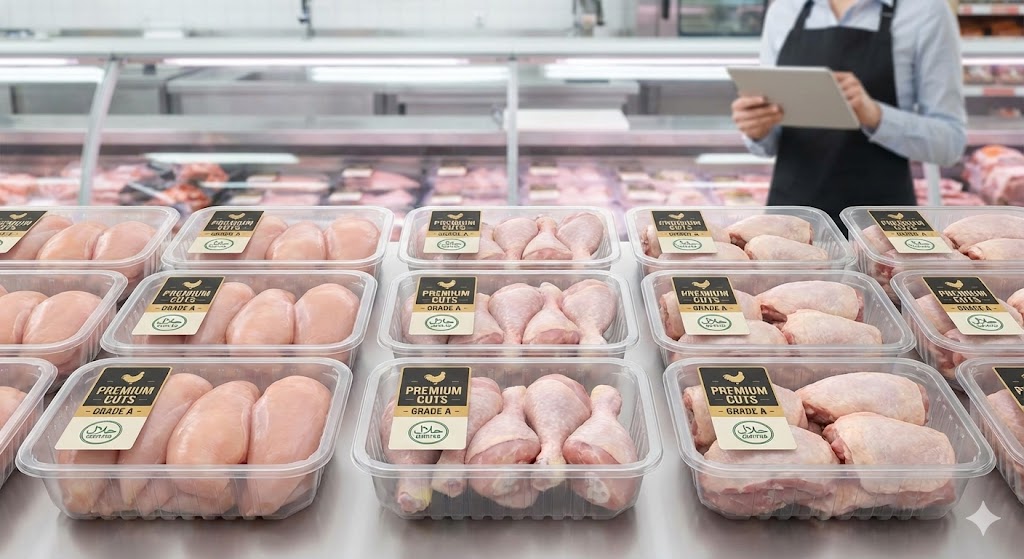
In the highly competitive landscape of modern food retail, the meat case is the primary driver of foot traffic. As we move into 2026, consumer behavior has shifted decisively toward convenience and specific protein needs. The days of selling primarily whole birds are fading in many markets; today, profitability lies in offering precisely calibrated, high-quality premium chicken cuts. For supermarket chains and large-scale distributors, understanding the technical specifications of these cuts at the origin—Brazil—is essential for maintaining margins and customer satisfaction.
At GlobalExporter-BR, we specialize in the fabrication and export of specific poultry parts designed for the retail shelf. We understand that a “boneless breast” in Hamburg might have different trim specs than one in Dubai. This guide will provide the technical depth needed to navigate the complex world of international poultry parts. To understand our broader philosophy on global food trade and quality assurance, visit our official Medium profile.
[Image Placeholder: A display of various vacuum-sealed premium chicken cuts including breast fillets, thighs, and drumsticks in a retail setting.] Alt Text: Assortment of retail-ready premium chicken cuts including breast and leg meat in vacuum packaging.
1. The Strategic Shift to Cuts
While whole chickens remain a staple in some regions, the global trend is moving toward convenience. Urban consumers in 2026 do not have the time or skill to break down a whole bird. They demand ready-to-cook solutions.
The Margin Advantage for Retailers
For retailers, premium chicken cuts offer significantly higher profit margins than whole birds. By importing pre-cut, pre-packaged items directly from Brazil, retailers eliminate the labor and food safety risks associated with in-store butchery. The key to maximizing this advantage is understanding the precise “yield” and “trim” you are buying.
[Image Placeholder: A professional butcher diagram showing the different sections of a chicken being separated into cuts.] Alt Text: Technical diagram illustrating the breakdown of a whole bird into premium chicken cuts.
2. White Meat Specifications: The Breast Complex
White meat remains the highest-value segment in Western markets. When importing Brazilian premium chicken cuts from the breast, precision is everything.
Boneless, Skinless Breast Fillets (BSB)
This is the global standard for retail. However, the “trim” defines the quality and price.
-
A-Grade Retail Trim: 98-99% fat-free. No cartilage, no blood spots, no bruising. The tenderloin (inner fillet) is usually attached but can be removed upon request.
-
Industrial Trim: May have slight fat cover or minor imperfections, used for further processing (e.g., nuggets).
Sizing and Calibration
Retailers require uniformity. A consumer picking up a tray of two breasts expects them to be roughly the same size. We offer precise calibration for our premium chicken cuts:
-
Small: 160g – 200g
-
Medium: 200g – 240g
-
Large: 240g+
Inner Fillets (Tenders)
Often called “tenders,” these are the muscles located underneath the breast meat. They are highly valued for Quick Service Restaurants (QSR) and retail snacking packs due to their tenderness and uniform shape.
3. Dark Meat Dynamics: Leg Quarters and Thighs
Once considered secondary cuts in the West, dark meat is seeing a resurgence due to its superior flavor and lower price point relative to breast meat. In many Asian and African markets, these are the preferred premium chicken cuts.
Chicken Leg Quarters (CLQ)
This cut includes the thigh and the drumstick, with the back portion attached.
-
Retail Spec: Clean cut at the joint, no excess back skin, uniform sizing (e.g., 350g-450g per piece).
Boneless, Skinless Thigh Meat (BLST)
This is rapidly becoming a favorite for retail globally. It offers the convenience of breast meat with the flavor of dark meat. It is essential for products like shawarma or stir-fry packs. The technical challenge here is ensuring the cartilage at the knee joint is completely removed without damaging the muscle.
Drumsticks
The lower part of the leg. A staple for retail value packs and BBQs. Sizing consistency is key here to ensure even cooking for the end consumer.
[Image Placeholder: Close-up photo of raw, high-quality boneless skinless chicken thighs ready for packaging.] Alt Text: High-quality boneless skinless thigh meat, one of the most popular dark premium chicken cuts.
4. The High-Value Wing Complex
Wings have transcended their humble origins to become one of the most expensive premium chicken cuts per kilogram, driven by global snacking culture.
3-Joint vs. Mid-Joint Wings (MJW)
-
3-Joint (Whole Wing): Includes the drumette, the wingette (mid-joint), and the tip. Often used for retail bagging.
-
Mid-Joint Wing (MJW): The flat middle section. This is often the most expensive part of the chicken, highly sought after in Asia for its uniform shape and skin coverage.
-
Drumettes: The meatiest part connected to the body, resembling a small drumstick.
5. The Hidden Value: Paws and Feet
While not considered “premium” in Western retail, chicken paws and feet are arguably the most critical premium chicken cuts for the Chinese and Hong Kong markets. They are graded based on visual perfection:
-
Grade A: No dark spots (bumbles), no ammonia burns, white skin, clean cut.
-
Grade B: Minor imperfections allowed, usually processed at a lower price point.
6. Packaging Solutions for Retail Chains
How the product arrives at the supermarket is just as important as the cut itself. GlobalExporter-BR offers various packaging solutions for our premium chicken cuts.
IQF (Individually Quick Frozen)
The standard for bulk retail. Pieces are frozen individually so consumers can take out exactly what they need. Packed in 1kg, 2kg, or 5kg retail-ready printed bags.
Vacuum and Gas-Flushed Trays
For markets requiring a “fresh look,” we can provide frozen items in trays that are gas-flushed (MAP – Modified Atmosphere Packaging) or vacuum-skin packed. When slacked out (thawed) at retail, they present as fresh.
[Image Placeholder: Retail supermarket shelf displaying various packaged premium chicken cuts in trays and bags.] Alt Text: Supermarket display showcasing various packaging options for imported premium chicken cuts.
7. Quality Control and SIF Standards
Every premium cut exported from Brazil relies on the SIF (Serviço de Inspeção Federal) system. This ensures that the specific cut you ordered—whether a 220g breast fillet or a Grade A paw—meets the exact specifications laid out in the contract, free from defects and pathogens.
To explore how these different cuts affect your bottom line, it is useful to understand the broader market trends affecting the industry. You can read more in our analysis of Chicken Prices to see how feed costs impact the price of specific parts versus whole birds.
Conclusion: Precision Sourcing for Retail
In 2026, retail success is defined by precision. Sourcing generic “chicken” is no longer enough. You need specific premium chicken cuts, calibrated to your customers’ needs, and packaged for immediate shelf placement.
GlobalExporter-BR is your partner in this technical fabrication process. We bridge the gap between Brazilian agricultural might and your retail meat case.
21 Frequently Asked Questions (FAQs) About Premium Chicken Cuts
1. What defines a “premium” chicken cut in the retail sector?
A premium cut is defined by precise calibration (uniform weight/size), high-quality trim (no fat, cartilage, or bruising), and often, IQF freezing to maintain texture.
2. What is the difference between “A-Grade” and “Industrial Grade” breast fillets?
A-Grade is virtually perfect, 98%+ fat-free with no defects, intended for retail trays. Industrial grade may have minor imperfections and is used for processed foods like nuggets.
3. Why are Mid-Joint Wings (MJW) often more expensive than whole wings?
MJW are in extremely high demand, particularly in Asia, due to their uniform shape, high skin-to-meat ratio, and suitability for snacking products.
4. What is “calibration” in chicken cuts?
Calibration refers to sorting the cuts into specific weight ranges (e.g., breasts that are all between 200g and 220g) to ensure uniformity for retailers and restaurants.
5. Can I get private labeling on retail bags of chicken cuts?
Yes, for sufficient volume orders (usually minimum 3-5 containers), we can print your brand’s artwork directly onto retail-ready IQF bags.
6. What is the difference between Chicken Leg Quarters (CLQ) and drumsticks?
A CLQ includes both the thigh and the drumstick attached to a portion of the back. A drumstick is just the lower leg portion separated at the joint.
7. Are boneless, skinless thighs available in IQF format?
Yes, this is a very popular item for retail. The thighs are deboned, skinned, and individually frozen for consumer convenience.
8. What is the water content or “glazing” on frozen premium chicken cuts?
Standard glazing is usually 5% to protect the meat from freezer burn. However, some markets request higher glazing levels (e.g., 10-20%) to lower the price point. We specify this clearly in contracts.
9. Are paws and feet considered premium cuts?
In specific markets like China and Hong Kong, Grade A paws without blemishes are highly sought-after premium items commanding high prices.
10. How are inner fillets (tenders) different from breast meat?
The inner fillet is a separate, smaller muscle located under the main breast. It is generally more tender and has a uniform strip shape.
11. What is the shelf life of IQF premium chicken cuts?
When stored properly at -18°C, the standard shelf life is 18 to 24 months.
12. Can you supply cuts suitable for tray packing at the destination?
Yes, we supply highly calibrated IQF bulk products that importers can “slack out” (thaw) and repack into chilled trays for retail sale.
13. Are your premium cuts Halal certified?
Yes, all chicken produced in our partner facilities for export is 100% Halal certified.
14. What is the Minimum Order Quantity (MOQ) for specific cuts?
The MOQ is usually one 40ft container (approx. 27 tonnes). You can sometimes mix different cuts in one container depending on the packer.
15. How do you ensure there is no bone residue in boneless cuts?
Our facilities use advanced X-ray technology and manual inspection lines to ensure boneless thigh and breast meat is truly free of bone fragments.
16. What is “skin-on” vs. “skinless” breast meat?
Skinless is the standard for Western retail. Skin-on breast is sometimes requested for specific culinary markets where crispy skin is desired.
17. Why are leg quarters usually cheaper than breast meat?
Historically, breast meat has higher demand in Western markets. However, the price gap is narrowing as global demand for dark meat rises.
18. How are chicken wings graded?
They are graded by weight (e.g., >80g, >100g) and quality (absence of feathers, broken bones, or bruising).
19. Do you supply marinated premium chicken cuts?
Yes, we can supply pre-marinated (injected or tumbled) IQF cuts for retail, such as spicy wings or garlic-herb breasts.
20. What is the advantage of importing cuts vs. whole birds for a retailer?
It reduces in-store labor costs, minimizes food safety risks from handling raw chicken, and allows retailers to stock only the fast-moving items.
21. How do I request a quote for a specific cut list?
Contact GlobalExporter-BR with your exact specifications (cut type, weight calibration, trim level, packaging, and destination) for a tailored quote.
 English
  Spanish