
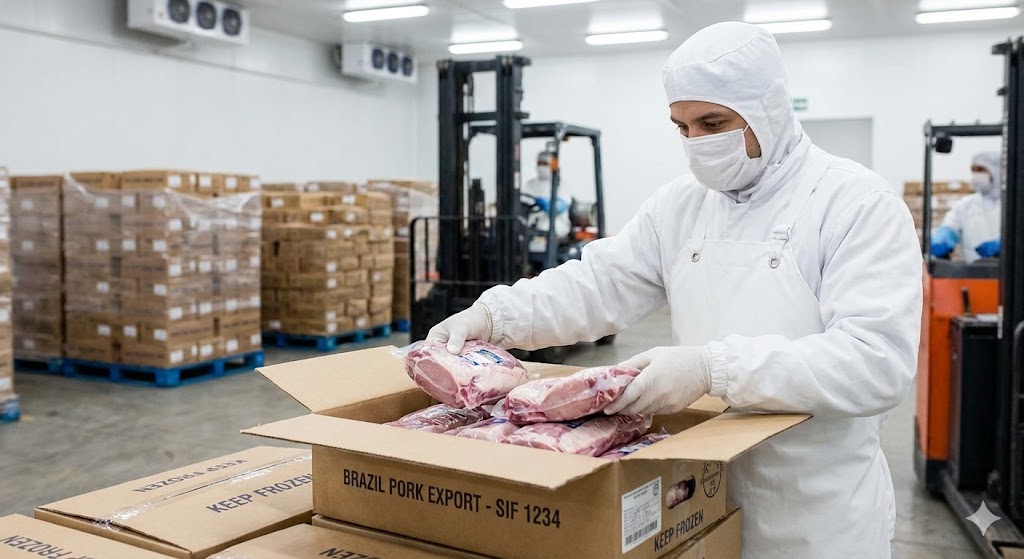
In the volatile landscape of global protein trade, stability is the most valuable commodity. As we enter 2026, the global pork export market is characterized by a stark contrast between regions plagued by disease and those offering security. For international procurement officers, retailers, and food processors, Brazil has emerged not just as an alternative, but as the premier partner for safe, high-quality, and scalable pork solutions.
At GlobalExporter-BR, we help international buyers navigate the complexities of sourcing animal protein from South America. While Brazil is famous for beef and poultry, its swine industry is rapidly modernizing to meet global standards of welfare and biosecurity. To understand more about our holistic approach to food trade, visit our official profile on Medium.
[Image Placeholder: A modern, clean Brazilian pork processing facility showing automated cutting lines and quality control inspectors.] Alt Text: Inside a modern Brazilian facility dedicated to high-quality pork export.
1. The 2026 Global Context for Pork Export
To understand why Brazil is winning, one must look at the challenges facing its competitors. The lingering effects of African Swine Fever (ASF) continue to disrupt production in major Asian markets and parts of Eastern Europe. This has created a structural deficit in the global supply chain.
Brazil as the “Safe Harbor”
Brazil’s primary advantage in the pork export sector is its unique sanitary status. The southern states of Brazil, particularly Santa Catarina, are recognized by the World Organisation for Animal Health (WOAH/OIE) as “Free of Foot-and-Mouth Disease (FMD) without vaccination.”
For a B2B buyer in Japan, South Korea, or Chile, this status is non-negotiable. It means that Brazilian pork can enter high-value markets that are closed to other major producers.
[Image Placeholder: A map of Brazil highlighting the southern states and their OIE disease-free status for pork production.] Alt Text: Map illustrating Brazil’s disease-free zones crucial for international pork export.
2. The Economics of Sourcing Brazilian Pork
While biosecurity gets the pork through customs, economics is what closes the deal. Similar to our advantage in chicken prices, Brazil’s pork industry benefits from vertical integration.
The Grain-Meat Connection
Pigs are grain-intensive animals. Brazil is a global powerhouse in corn and soy production, meaning our farmers do not rely on expensive imported feed. This internal supply of primary inputs shields Brazilian pork export prices from the extreme volatility seen in European or North American markets, providing long-term price stability for our partners.
If you are looking to balance your protein portfolio, Brazil offers a unique opportunity to source poultry, beef, and pork under one logistics umbrella. Visit our homepage to see our full range of exportable proteins.
3. Technical Guide: Key Pork Cuts for the International Market
A successful pork export strategy requires understanding regional preferences. Brazilian packers are highly flexible and able to fabricate cuts to precise international specifications.
High-Value Cuts (Retail & Food Service)
-
Loin (Lombo): The premium, lean cut. Brazilian boneless loins are prized in Europe and North America for their uniformity and tenderness.
-
Tenderloin (Filé Mignon Suíno): The most tender muscle, commanding the highest price point in fine dining sectors.
-
Ribs (Costelinha): St. Louis style or Baby Back ribs are in high demand for the global BBQ and casual dining sectors.
Industrial & Asian Market Cuts
-
Bellies (Barriga): The essential cut for bacon production. Brazil’s ability to supply high-fat, well-marbled bellies makes it a key supplier for processors globally.
-
Offal and By-products: The Asian market, particularly China and Hong Kong, has a massive demand for feet, ears, snouts, and internal organs. Brazil has specialized infrastructure to harvest, clean, and freeze these items to the exacting standards required for export.
[Image Placeholder: A display of various vacuum-packed raw pork cuts including loin, ribs, and belly, ready for shipping.] Alt Text: Various premium cuts ready for pork export from Brazil, including loin and ribs.
4. Logistics: The Cold Chain for Frozen Pork
Exporting pork requires the same rigorous cold chain management as our beef meat or fresh chicken operations. Pork fat can go rancid if temperatures fluctuate.
The -18°C Standard
We ensure that all frozen pork destined for export is blast-frozen immediately after processing and maintained at a strict -18°C (0°F) throughout its journey. We utilize the southern ports of Itajaí and Paranaguá, which have specialized reefer terminals dedicated to refrigerated cargo, ensuring efficient loading and minimal dwell time.
5. Sustainability and Animal Welfare in Pork Production
The 2026 market is increasingly demanding higher welfare standards. Brazil is responding by moving away from traditional gestation crates toward group housing systems for sows. This is not just an ethical move; it is a commercial necessity to maintain access to the sophisticated European retail market.
When you source pork export products from GlobalExporter-BR, you are partnering with producers who are adopting “Green Pork” initiatives, focusing on waste management (biodigesters) and reduced carbon footprints.
21 Frequently Asked Questions (FAQs) About Pork Export
1. Why is Brazil considered a safe origin for pork export?
Brazil has vast regions, specifically in the south, certified by the OIE as free from major swine diseases like FMD and ASF without vaccination, guaranteeing access to demanding markets.
2. What are the main destinations for Brazilian pork exports?
China remains the largest buyer, followed by Hong Kong, Chile, Japan, South Korea, and increasingly, neighboring South American countries.
3. How do Brazilian pork prices compare to US or European prices?
Brazil is highly competitive due to low domestic feed costs (corn/soy), often making it more affordable than European origins, especially for industrial cuts.
4. Can I import fresh (chilled) pork from Brazil?
Due to transit times, the vast majority of global pork trade is frozen. Chilled pork is usually limited to regional trade within South America.
5. What is the Minimum Order Quantity (MOQ) for pork export?
The standard MOQ is one 40ft refrigerated container (FCL), which typically holds between 25 and 27 metric tonnes of frozen product.
6. Is Brazilian pork Halal certified?
No. Pork is “Haram” (forbidden) in Islam. It is never Halal certified and is strictly segregated from our Halal poultry and beef operations.
7. What cuts are most popular for the Chinese market?
China imports a wide variety, but there is massive demand for offal (feet, heads, ears), bellies for bacon, and increasingly, premium loins.
8. Does Brazil use ractopamine in pork production?
Brazil has segregated production lines. While some production uses it, we supply ractopamine-free pork specifically for markets that ban it, such as China and the EU. You must specify this requirement.
9. What certificates are required for pork export?
Key documents include the International Sanitary Certificate issued by MAPA, Certificate of Origin, Commercial Invoice, and Packing List.
10. How is the pork packaged for export?
Most cuts are individually vacuum-packed (IVP) or layer-packed (IWP) inside master cardboard cartons. Industrial cuts may be block frozen naked in polybags.
11. What is the shelf life of frozen export pork?
When stored properly at -18°C, frozen pork has a shelf life of 18 to 24 months.
12. Can I consolidate pork with chicken or beef in one container?
Yes, provided all products are frozen and the destination country’s import regulations allow for mixed animal proteins in a single shipment.
13. Are there seasonal fluctuations in pork export prices?
Yes, prices often rise in Q4 ahead of the Chinese New Year holidays due to a surge in demand for festive foods.
14. How do I ensure the cold chain was maintained?
We use temperature data loggers in every reefer container, providing you with a complete readout of the transit temperatures upon arrival.
15. What are the payment terms for new international buyers?
Standard terms are usually an irrevocable Letter of Credit (L/C) at sight or a percentage TT deposit with the balance against shipping documents.
16. Does GlobalExporter-BR handle customs clearance at destination?
No, we handle export clearance in Brazil (FOB or CIF). You are responsible for import clearance and duties at your destination port.
17. How does Brazilian pork quality compare to other origins?
Brazilian pork is known for good color, firm texture, and excellent fat quality due to the corn-based diet, making it comparable to top-tier North American product.
18. What is the lead time for a pork export order?
Depending on the specific cuts requested, production lead times are typically 15 to 25 days from contract confirmation.
19. Can I get private labeling on pork products?
Yes, for sufficient volume, processors can apply your brand’s labels to the inner packs and master cartons.
20. Why should I choose GlobalExporter-BR for pork?
We provide access to SIF-certified, disease-free plants in Southern Brazil and offer transparent, reliable logistics for long-term partnership.
21. How do I start a pork inquiry?
Visit the contact section on globalexporter-br.com and provide your target specs, volume, and destination port for a quote.
 English
  Spanish