
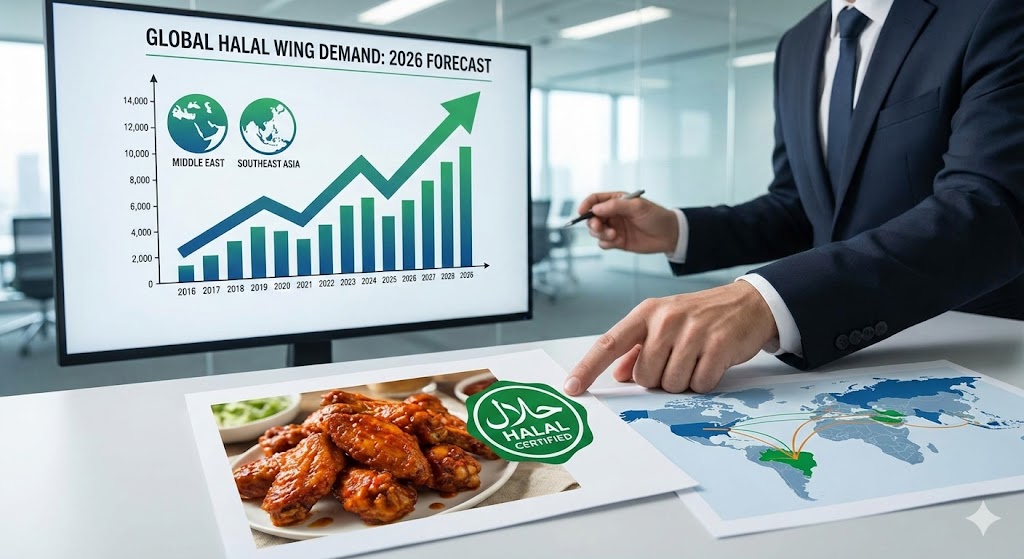
In the high-velocity world of agricultural commodities, few products have seen a price trajectory as fascinating as halal chicken wings. Once considered a secondary cut in the global poultry hierarchy, wings have ascended to become a primary profit driver for international exporters and a staple for global food service. As we move into 2026, the economics of this specific cut are being reshaped by a combination of surging regional demand in Islamic markets and Brazil’s unmatched production capacity.
At GlobalExporter-BR, we recognize that for our B2B partners, the “Halal” designation is not just a religious requirement; it is a massive economic gateway. Understanding the nuances of the halal chicken wings market—from certification costs to regional freight advantages—is essential for any procurement officer looking to optimize their 2026 strategy. To learn more about our role as a leading bridge between Brazilian producers and global markets, you can visit our official profile on Medium.
Alt Text: Market-ready halal chicken wings highlighting the economic value of Halal certification in 2026.
1. The “Wing Effect”: Why This Cut Dominates 2026 Economics
The economics of halal chicken wings are unique because they are driven by “snack culture” and the “sharing economy.” Unlike whole birds or breast fillets, which are often consumed as primary meals at home, wings are the “hero product” of the Quick Service Restaurant (QSR) and sports-bar sectors.
The Inelasticity of Demand
In the Gulf Cooperation Council (GCC) and Southeast Asian markets, the demand for halal chicken wings has become relatively inelastic. Even when global chicken prices rise, consumers in Riyadh, Dubai, and Jakarta continue to purchase wings. This makes them a high-margin, low-risk item for importers. By sourcing through a Global Exporter BR, buyers can secure the volumes needed to satisfy this consistent appetite. If you are interested in seeing our current availability and technical specs, visit our homepage.
2. Regional Demand Analysis: The GCC and SE Asia
In 2026, the global market for halal chicken wings is anchored by two massive regional hubs.
The GCC Market (Saudi Arabia, UAE, Qatar)
The Middle East remains the most sophisticated market for Halal poultry. Here, the demand is for “Grade A” 3-joint wings and drumettes.
-
Economic Driver: High disposable income and a massive hospitality sector.
-
Standard: Importers here demand GSO-standard certification, which involves strict manual slaughtering and zero stunning—a process that Brazil has perfected over decades of trade.
The Southeast Asian Market (Indonesia, Malaysia, Vietnam)
In this region, the preference shifts toward “Mid-Joint Wings” (MJW).
-
Economic Driver: Massive populations and a booming street-food culture.
-
Standard: Compliance with JAKIM (Malaysia) and BPJPH (Indonesia) is the non-negotiable entry requirement. The economics here are volume-driven, requiring massive, steady shipments from the Brazilian interior.
Alt Text: International trade routes for halal chicken wings from Brazil to major regional demand hubs.
3. The Brazilian Supply Chain Advantage
Why does Brazil control the economics of halal chicken wings? It comes down to “Feed to Meat” conversion efficiency.
Vertical Integration and Feed Security
Brazil’s status as a top producer of corn and soy allows our poultry plants to maintain the lowest production costs per kilo. While European producers struggle with high energy and imported feed costs, Brazilian halal chicken wings remain price-competitive because the raw inputs are grown right next to the processing plants.
Alt Text: Diagram showing the vertical integration of halal chicken wings production in Brazil.
4. Certification: The Value-Add Multiplier
A common question from new B2B buyers is: “Why does the Halal label increase the value of the wing?” The answer lies in the audit trail. To produce halal chicken wings, a plant must undergo:
-
Religious Audits: Regular inspections by bodies like FAMBRAS or Cdial.
-
Separate Logistics: Ensuring no cross-contamination with non-halal products.
-
Specialized Labor: Hiring certified Muslim slaughtermen.
These steps add a layer of quality control that is effectively a “Safety Premium.” This premium is why halal chicken wings often command a higher price than non-certified wings in the international market, yet they offer much higher market access.
5. Logistics: The Cold Chain for Bulk Wing Export
Shipping halal chicken wings requires a “Zero-Break” cold chain at -18°C. Because wings have a high surface-area-to-meat ratio, they are particularly susceptible to freezer burn if the temperature fluctuates. At GlobalExporter-BR, we utilize IoT-enabled reefer containers to ensure that every wing arrives in “Grade A” condition, preserving its economic value.
For buyers also managing high-end retail, understanding how these wings compare to Beef Meat grading can help in creating a balanced inventory that satisfies both budget-conscious and premium-seeking customers.
21 Frequently Asked Questions (FAQs) About Halal Chicken Wings
1. What makes chicken wings “Halal”?
The birds must be healthy at the time of slaughter, which must be performed by a Muslim who recites the Tasmiyah. All blood must be drained, and the process must be certified by a recognized body.
2. Is there an economic difference between 3-joint wings and mid-joint wings?
Yes. Mid-joint wings (MJW) are typically more expensive per kilogram because they are highly sought after in Asian markets for their uniform shape and skin-to-meat ratio.
3. Why is Brazil the top exporter of halal chicken wings?
Brazil offers the best combination of low feed costs, massive production scale, and decades of experience in meeting GSO and JAKIM Halal standards.
4. How do chicken prices for wings compare to breast meat?
Interestingly, in some seasons, wing prices can exceed breast meat prices due to extreme demand from the QSR (Fast Food) sector.
5. What is the shelf life of frozen halal chicken wings?
When maintained at -18°C, they have a shelf life of 18 to 24 months.
6. Do you offer “Grade A” and “Grade B” wings?
Yes. Grade A is for retail/food service (no bruises, no broken bones). Grade B is often used for industrial processing or budget markets.
7. What is the Minimum Order Quantity (MOQ) for halal chicken wings?
The MOQ is typically one 40ft refrigerated container, which holds approximately 27 tonnes.
8. Does GlobalExporter-BR provide Halal certificates with every shipment?
Yes. Every shipment is accompanied by an original Halal certificate issued by an accredited Brazilian body recognized by the destination country.
9. What are the primary packaging options for wings?
Standard packaging is 10kg, 12kg, or 15kg cartons. Retail-ready 1kg or 2kg bags are also available for large-volume contracts.
10. How does “Drip Loss” affect the economics of wings?
Low-quality wings with high water injection (glazing) have high drip loss, meaning the buyer pays for water. Brazilian wings are known for low glazing and high meat yield.
11. Are these wings suitable for the Chinese market?
Yes. While China is not a Muslim-majority country, the quality standards for Halal production often exceed standard requirements, making them a preferred choice for Chinese importers.
12. What is the difference between “Drumettes” and “Wingettes”?
The drumette is the meaty part resembling a small drumstick. The wingette is the middle, flat part (mid-joint).
13. Can I get breaded or marinated halal chicken wings?
Yes, we offer value-added “Ready-to-Cook” options that are already seasoned or breaded in a Halal-compliant facility.
14. How do freight costs affect the price of wings?
Freight can account for 10-15% of the landed cost. Sourcing from a Global Exporter BR with high shipping volume often allows for better freight rates.
15. Is stunning used in the Halal slaughter of Brazilian wings?
We offer both “No-Stunning” and “Reversible Stunning” options, depending on the specific requirements of the importing country (e.g., UAE vs. Malaysia).
16. What is the current demand trend for 2026?
We expect a 5-7% growth in demand for halal chicken wings as western-style wing franchises continue to expand across Saudi Arabia and Indonesia.
17. How do I verify a Brazilian Halal certificate?
You can verify the certificate via the QR code or serial number directly with the issuing body (FAMBRAS, Cdial, etc.).
18. Why are wings considered an “Inelastic” commodity?
Because they are a “habitual” snack food. Consumers are less likely to stop buying wings during an economic downturn compared to expensive cuts like tenderloin beef.
19. Can I mix a container with wings and other chicken parts?
Yes, most packers allow for “Mixed Loads” (e.g., 50% wings, 50% leg quarters), provided they are all from the same facility.
20. Does GlobalExporter-BR export to Europe?
Yes, we serve the European Halal market, which is growing rapidly in countries like France, Germany, and the UK.
21. How do I get an immediate quote for a bulk order?
Visit our contact page and provide your target port and volume for a 24-hour turnaround on pricing.
 English
  Spanish