
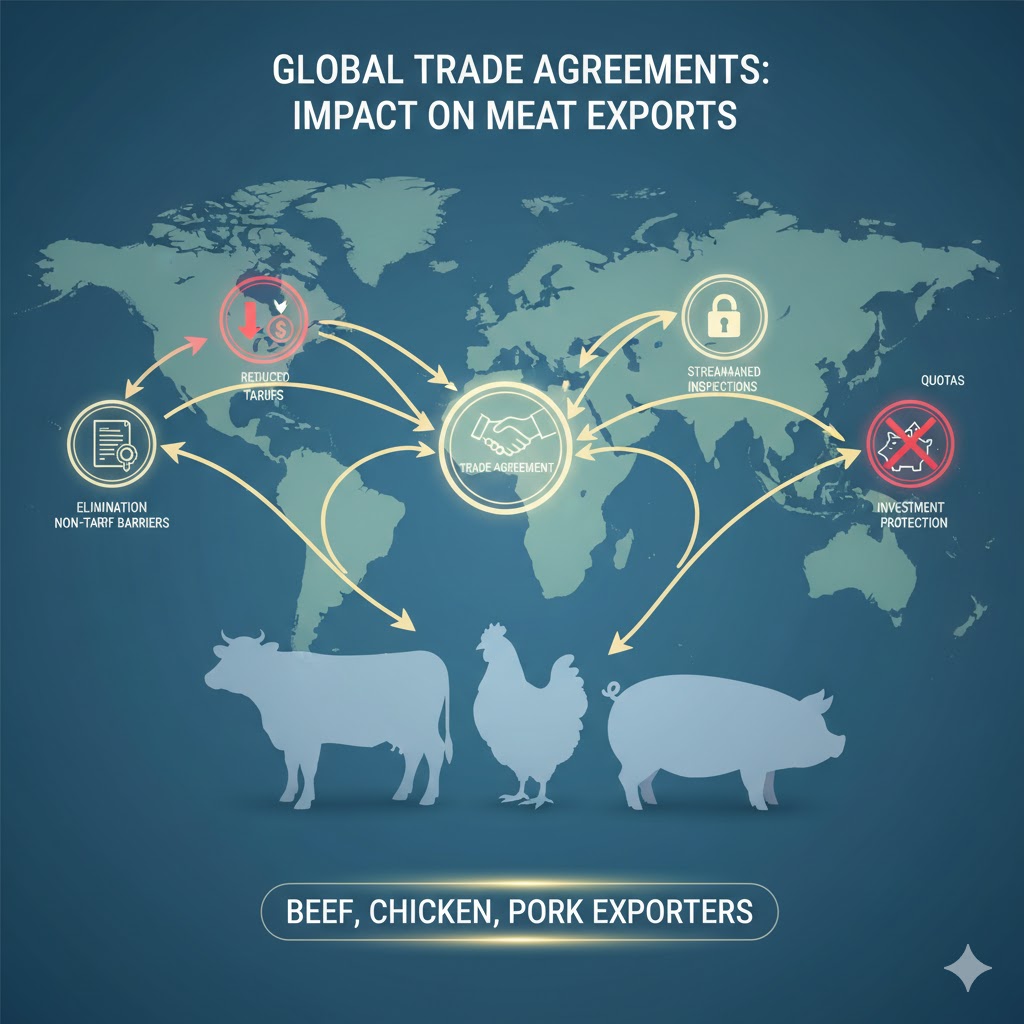
Why Trade Agreements Matter in Meat Exports
For meat exporters—especially those dealing in beef, chicken, and pork—global trade is more than logistics. It’s shaped by trade agreements, government policies, and sanitary regulations that either lower barriers or create obstacles.
From Brazilian chicken exports to Saudi Arabia, to U.S. beef shipments to Japan, and European pork exports to China—each transaction is influenced by trade rules.
In short: Without trade agreements, exporters face higher tariffs, longer customs delays, and even market bans. With them, access to global markets becomes easier, profits rise, and exporters gain stability.
This article explains exactly how trade agreements impact meat exporters, who benefits the most, and how companies like GlobalExporter-Br.com navigate them successfully.
1. What Are Trade Agreements?
Trade agreements are legal contracts between countries that determine how goods are traded. They can:
✅ Lower or eliminate tariffs (import taxes)
✅ Streamline customs procedures
✅ Harmonize food safety standards
✅ Increase trust between governments
✅ Promote long-term supply contracts
Types of Trade Agreements:
| Type | Example | Impact on Meat Exporters |
|---|---|---|
| Bilateral | Brazil – UAE | Reduces tariffs on halal chicken & beef |
| Multilateral | WTO Agreements | Applies rules to 160+ countries |
| Regional FTAs | USMCA, EU-Mercosur | Fosters regional meat trade |
| Preferential Trade Deals | GSP, AGOA | Lowers tariffs for developing nations |
2. How Trade Agreements Affect Beef Exporters
✅ Benefits for Beef Exporters
-
Lower Tariffs = Higher Profit Margins
-
Example: Under the EU-Mercosur Agreement, Brazilian beef gets preferential access to European markets.
-
-
Increased Market Access
-
Japan once restricted U.S. beef due to BSE (Mad Cow Disease). After trade negotiations, tariffs were reduced and exports surged.
-
-
Halal Certifications Included in Trade Docs
-
Middle Eastern countries accept Brazilian halal beef certificates under WTO sanitary agreements.
-
❌ Challenges for Beef Exporters
| Challenge | Real Example |
|---|---|
| Tariff rate quotas | EU limits how many tons of beef Brazil can export at reduced tariff rate |
| Sanitary barriers (SPS) | Bans due to foot-and-mouth disease or hormones in cattle |
| Sustainability pressure | EU demands deforestation-free supply chains for Brazilian beef |
3. Impact on Chicken Exporters
✅ Why Chicken Exporters Love Trade Agreements
-
Brazil, the world’s top chicken exporter, benefits from trade deals with over 150 countries.
-
Zero-duty access to markets like Saudi Arabia, UAE, Kuwait, Qatar for halal poultry.
-
Vietnam, Hong Kong, and Singapore have reduced tariffs under ASEAN trade rules.
Key Example:
Brazil + Middle East (GCC Trade Deals)
→ Halal-certified Brazilian chicken enters Saudi Arabia with 0% import duty, making Brazil the biggest supplier.
❌ Obstacles in Chicken Export
| Problem | Countries |
|---|---|
| Anti-dumping tariffs | South Africa vs Brazilian chicken (35% tariff) |
| Avian flu bans | EU, Japan temporarily ban imports from affected regions |
| Labeling laws | EU requires origin, farm location, slaughterhouse data |
4. How Trade Agreements Impact Pork Exporters
✅ Positive Effects
-
EU is the largest pork exporter, benefiting from zero-duty pork trade into China, Japan, and South Korea.
-
The USMCA (U.S.–Mexico–Canada Agreement) keeps pork tariffs at 0%.
-
Brazil has begun entering new pork markets such as Philippines, Vietnam, and Singapore thanks to trade reforms.
❌ Major Challenges
| Issue | Explanation |
|---|---|
| ASF (African Swine Fever) | Leads to total import bans — no trade agreement can override biosecurity laws |
| Religious restrictions | Pork banned in Gulf and Muslim-majority countries |
| Environmental rules | EU pork facing carbon footprint and animal welfare legislation |
5. Case Study: Brazil – A Winner in Trade Agreements
Brazil is a top global exporter of beef, chicken, and pork because it strategically uses trade agreements and has:
-
Mercosur trade bloc membership
-
Halal agreements with GCC countries
-
Strategic ties with China (largest beef and chicken importer)
-
Low-cost production + strong logistics (Santos, Paranaguá ports)
At GlobalExporter-Br.com, we use Brazilian trade benefits to supply:
✔ Frozen halal chicken
✔ Premium beef cuts
✔ Frozen pork products (to allowed markets)
6. Who Benefits the Most from Trade Agreements?
| Beneficiary | How They Gain |
|---|---|
| Exporters (B2B) | Better prices, less taxation, easier market entry |
| Importers & Wholesalers | More supply, stable pricing |
| Consumers | Cheaper beef, chicken or pork imports |
| Governments | Stronger economy, tax revenue, employment |
7. Risks & Limitations of Trade Agreements
Even with active trade agreements, meat exporters face:
-
✅ Market bans due to disease (BSE, Avian Flu, ASF)
-
✅ Quota restrictions on export volume
-
✅ Political disputes impacting trade (U.S.–China tensions)
-
✅ Environmental pushback (EU deforestation laws)
-
✅ Currency fluctuations disrupting profit margins
8. Strategies Exporters Should Follow
To succeed in global trade, meat exporters must:
✔ Understand tariffs and free trade agreements
✔ Get ISO, HACCP, HALAL, SIF certifications
✔ Maintain cold chain logistics from farm to port
✔ Build relations with importers, distributors & customs brokers
✔ Use Free Trade Zones (FTZs) for tax benefits
Trade Agreements Shape the Future of Meat Exports
Trade agreements are the backbone of international meat trade. Whether in beef, chicken, or pork, exporters who understand tariff systems, sanitary rules, and global supply chains gain a decisive advantage.
Brazil, the U.S., EU, and India are proof that combining agricultural excellence + trade strategy = export success.
At GlobalExporter-Br.com, we continue to expand into new markets using Brazil’s strong trade agreements, halal certifications, and world-class cold chain systems.
 Spanish
  English