
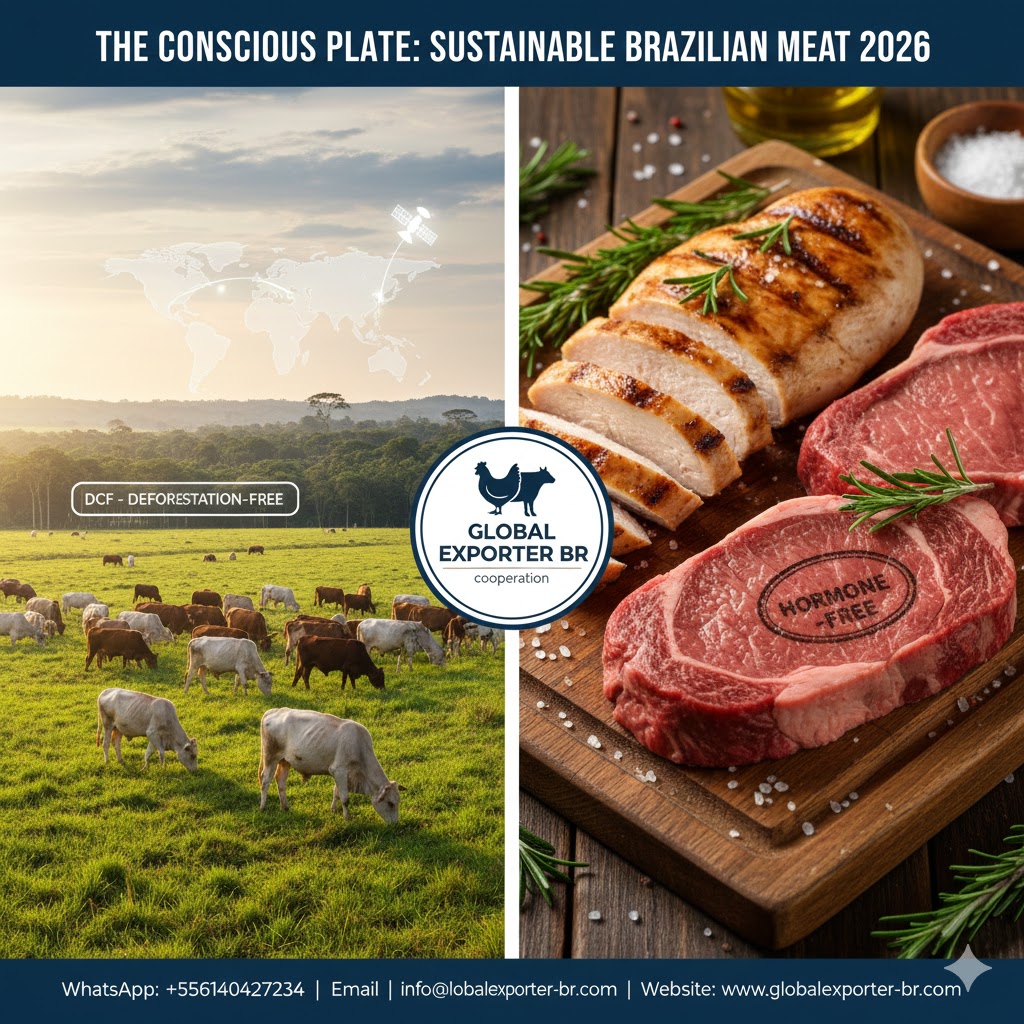
The global dining table is changing. In 2026, international buyers are no longer just asking “What is the price?” but also “How was it produced?” and “Is it healthy?” As the world’s leading supplier of animal protein, Brazil is evolving to meet these demands.
At Global Exporter BR, we are witnessing a major shift toward transparency, sustainability, and health-focused protein choices. Here is how the “Conscious Plate” trend is influencing our exports this year.
1. The “Lean and Clean” Revolution
Health remains the #1 driver for global protein consumption in 2026. This has solidified chicken’s position as the world’s most consumed meat, with global per capita availability reaching record highs.
-
Poultry’s Dominance: Because it is a lean protein with a lower carbon footprint, chicken is the preferred choice for health-conscious Gen Z and Millennial consumers.
-
Hormone-Free & Antibiotic-Free: Our partners now prioritize “Clean Label” products. Every shipment from Global Exporter BR adheres to strict “No Hormone” protocols, meeting the high standards of the EU and North American markets.
2. Sustainability & Traceability: The DCF Model
2026 is the year of Deforestation and Conversion-Free (DCF) meat. European and Asian buyers are increasingly requiring proof that their beef and pork do not contribute to forest clearing.
-
Satellite Tracking: Many of our SIF-certified partner plants now use satellite imagery to verify the origin of cattle, ensuring they come from sustainable, intensified pastures.
-
Carbon Reduction: By increasing “stocking rates” (more cattle per hectare) and using integrated crop-livestock-forest systems, Brazilian producers are lowering the carbon CO2e footprint per kilogram of meat.
3. Premiumization & Ready-to-Cook
Busy urban professionals in 2026 are looking for convenience without sacrificing quality.
-
Value-Added Products: We are seeing a surge in demand for marinated, pre-cut, and ready-to-cook Brazilian chicken and pork.
-
Premium Beef: Despite tighter beef supplies this year, the demand for “Gourmet” Brazilian cuts—like grass-fed Picanha and Ribeye—remains at an all-time high in luxury retail markets.
Frequently Asked Questions
-
Is Brazilian meat sustainable in 2026? Yes, Brazil is leading the way in DCF (Deforestation-Free) production models.
-
Why is chicken the most consumed meat in 2026? It’s seen as the healthiest, most affordable, and lowest-carbon animal protein.
-
Does Global Exporter BR offer organic chicken? Yes, we have specialized lines for organic and free-range poultry.
-
What is a “Clean Label” meat product? Meat that is free from artificial additives, hormones, and unnecessary preservatives.
-
How do you prove beef is deforestation-free? Through advanced traceability systems and satellite farm monitoring.
-
Are your products antibiotic-free? We offer “Raised Without Antibiotics” (RWA) options for specific international markets.
-
What is Gen Z’s favorite meat? Trends show Gen Z favors poultry and plant-based alternatives for environmental reasons.
-
Does Brazil export plant-based meat? Yes, several of our partner plants now produce high-quality plant-based protein.
-
What is “Intensified Ranching”? Raising more cattle on less land to preserve natural forests.
-
Is Brazilian beef grass-fed? Yes, the majority of Brazilian cattle are grass-fed, which is a key sustainability selling point.
-
Do you provide nutritional information? Yes, all export cartons include full nutritional labeling.
-
What is the most popular “convenience” cut? Pre-marinated chicken wings and sliced pork belly.
-
Is Halal meat considered “cleaner”? Many consumers believe Halal slaughtering standards ensure higher hygiene and animal welfare.
-
How much beef does the average person eat in 2026? Global averages are shifting, with a decrease in red meat in favor of poultry.
-
What is “Regenerative Agriculture”? Farming practices that actually improve soil health and capture carbon.
-
Does Global Exporter BR support animal welfare? We only work with plants that follow strict humane slaughtering protocols.
-
What is the “low-carbon” beef brand? A specific Brazilian certification for beef produced with offset carbon emissions.
-
Are your pork products hormone-free? Yes, Brazilian law prohibits growth hormones in pork production.
-
What is the 2026 outlook for “Lab-Grown” meat? While growing, traditional Brazilian “Natural” meat still holds 98% of the market.
-
Can I get salt-reduced processed meats? Yes, we offer “Clean Label” reformulations with lower sodium.
-
Does Brazil export to the “Vegan” market? We provide the raw ingredients (soy/corn) for many global plant-based brands.
-
What is a “Flexitarian”? Someone who eats mostly plants but occasionally consumes high-quality meat.
-
Is the “Conscious Plate” trend global? It started in Europe/USA but is now huge in China and the UAE.
-
How does Brazil help global food security? By providing massive volumes of affordable, high-quality protein.
-
What is the packaging used for sustainability? We are moving toward 100% recyclable export cartons.
-
Do you offer “Family Packs” for retail? Yes, we can customize inner packaging for retail-ready shelf display.
-
What is the fat content of your lean chicken breast? Usually less than 2-3%.
-
Is Brazilian pork safe from ASF? Yes, Brazil maintains a “Free of African Swine Fever” status.
-
What is the “Green Real”? A term for Brazil’s agricultural economy as it pivots to green exports.
-
Does Global Exporter BR use plastic-free packaging? We are testing biodegradable liners for our 10kg cartons.
-
What is the most popular pork cut for health-conscious buyers? Pork tenderloin (Lombo).
-
Can I track the carbon footprint of my container? Some of our logistics partners provide carbon-tracking reports.
-
Why choose grass-fed over grain-fed? Grass-fed is often higher in Omega-3 fatty acids and CLA.
-
Does your sugar also have sustainability certifications? Yes, our sugar mills are Bonsucro certified.
-
How is “Animal Welfare” verified? Through independent 3rd party audits (like WQS).
-
Is the water used in processing recycled? Most SIF plants now have advanced water-treatment and recycling systems.
-
What is your email for sustainability inquiries? info@globalexporter-br.com.
-
What is your WhatsApp? +556140427234.
-
Where can I see your certifications? On our website www.globalexporter-br.com.
-
Does Brazil comply with the Paris Agreement? The meat industry is a key part of Brazil’s strategy to hit its 2030 climate goals.
-
Can meat be part of a sustainable diet? Yes, especially when sourced from efficient, low-impact producers in Brazil.
-
Why Global Exporter BR? We combine global scale with a conscience.
Connect with Global Exporter BR:
-
WhatsApp: +556140427234
-
Email: info@globalexporter-br.com
-
Website: www.globalexporter-br.com
-
Address: Av. Sen. Attilio Fontana, 1501, Parque Sao Joao Paranagua, Brazil
 Spanish
  English