
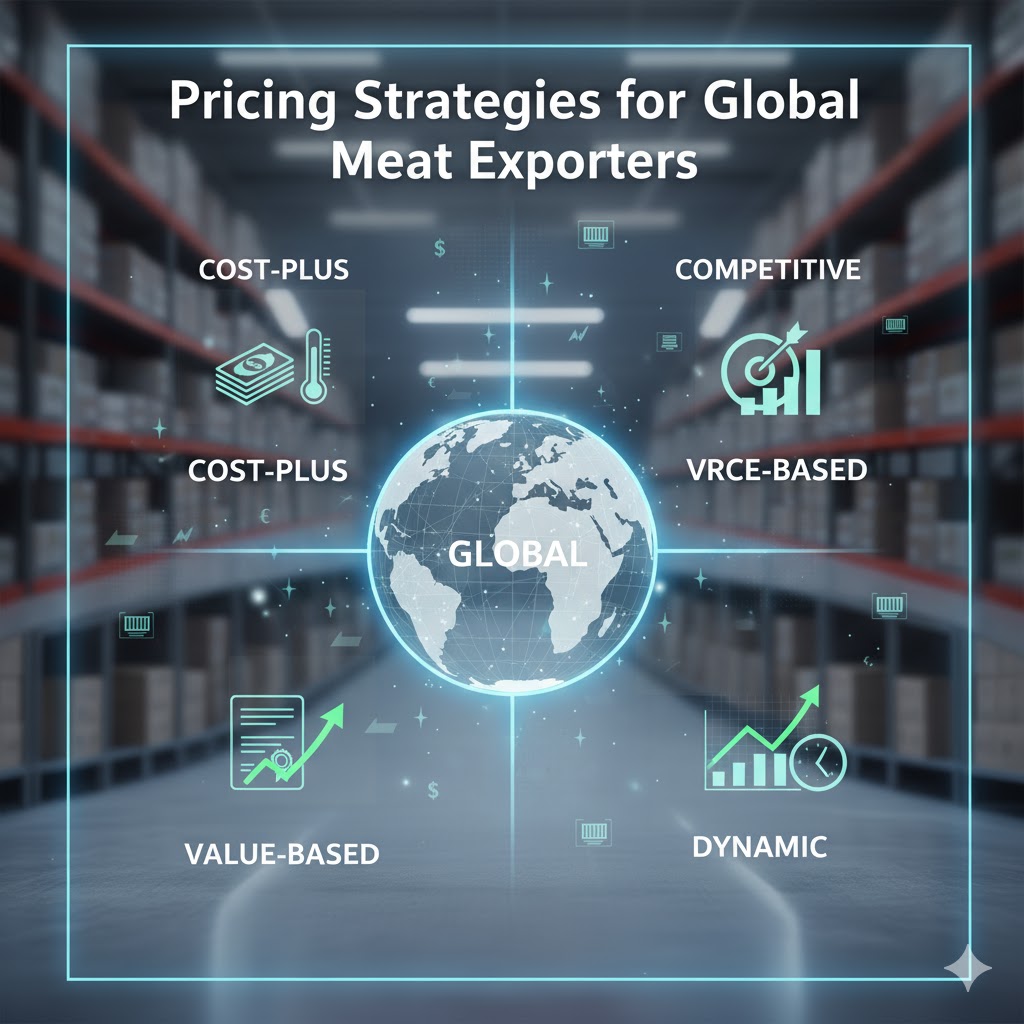
In today’s competitive food trade landscape, global meat exporters face one of the toughest challenges — setting the right price. Whether you’re exporting beef, chicken, or pork from Brazil to Asia, Africa, or the Middle East, your pricing strategy can determine your business success.
The meat export industry operates on thin margins, fluctuating logistics costs, and ever-changing market demands. A strong pricing plan not only helps maintain profitability but also positions your brand as a trusted and stable supplier.
At GlobalExporter-BR, we understand that every buyer, region, and market condition demands a customized approach. This article explores how exporters can design effective pricing strategies for global meat markets, balancing competitiveness, quality, and sustainability.
Focus Keyphrase: Pricing Strategies for Global Meat Exporters
Secondary Keywords: meat export pricing, beef export prices, chicken export from Brazil, pork export costs, meat trade trends, export market analysis, global meat supply chain.
1. Why Pricing Strategy Matters in Meat Exports
Setting prices in the global meat trade isn’t just about covering costs — it’s about understanding your target market, buyer expectations, and global supply trends.
A well-planned pricing strategy allows exporters to:
- Stay competitive without compromising quality.
- Protect profit margins during market volatility.
- Build long-term buyer trust through transparent pricing.
- Manage currency fluctuations and shipping costs efficiently.
For exporters in Brazil, pricing is influenced by multiple factors such as feed costs, exchange rates, logistics expenses, and trade tariffs.
To succeed, you must combine data-driven insights with market adaptability — a balance that leading companies like GlobalExporter-BR consistently maintain.
2. Factors That Influence Meat Export Prices
Before setting prices, exporters must evaluate all direct and indirect cost factors affecting their products.
1. Production Costs
These include feed, labor, animal care, processing, packaging, and cold storage. For example, fluctuations in soybean and corn prices directly impact the cost of raising livestock in Brazil.
2. Currency Exchange Rates
The Brazilian real (BRL) to U.S. dollar (USD) exchange rate has a massive effect on international pricing. A weaker real often boosts export competitiveness, while a stronger one can reduce profit margins.
3. Transportation and Logistics
Shipping costs can represent 10–25% of the final price of exported meat. Global freight rate changes — especially in reefer containers — can heavily influence pricing.
4. Trade Agreements and Tariffs
Countries with free trade agreements (FTAs) enjoy reduced tariffs, while others face import duties that must be reflected in final pricing.
5. Market Demand
Rising pork demand in Asia, beef consumption in the Middle East, or poultry growth in Africa — all shape how exporters set their prices.
6. Certification and Compliance Costs
Meeting Halal, ISO, or HACCP standards requires documentation, audits, and certification — adding costs but increasing buyer trust and access to premium markets.
3. Types of Pricing Strategies in the Global Meat Export Industry
Let’s explore the most effective pricing models that exporters can apply to different markets.
1. Cost-Plus Pricing
A straightforward method — calculate total production and logistics costs, then add a fixed profit margin.
Best for: Stable, long-term contracts or government tenders.
Example: A Brazilian exporter adds a 15% markup to cover margin and risk.
2. Market-Based Pricing
Set prices according to market trends, competitor rates, and consumer demand.
Best for: Dynamic markets like Asia and Latin America.
Example: Lowering pork prices during oversupply seasons to maintain volume.
3. Value-Based Pricing
Focus on perceived product quality — such as premium, grass-fed beef or antibiotic-free chicken.
Best for: High-income regions (e.g., Japan, UAE, and EU).
Example: Selling premium beef cuts at a higher price due to superior marbling and certification.
4. Penetration Pricing
Used when entering a new market — offering lower prices initially to gain trust and volume.
Best for: New exporters or emerging markets.
Example: Discounted chicken leg quarters for first-time Asian distributors.
5. Dynamic Pricing
Adjust prices based on real-time data, including exchange rates and shipping costs.
Best for: Tech-savvy exporters using market analytics platforms.
Example: Automatically updating pork export prices weekly based on freight changes.
4. Regional Price Variation: Where Meat Prices Differ Most
Different markets value meat differently due to income levels, import taxes, and consumer preferences.
| Region | Popular Meat | Average Import Price (USD/KG) | Market Notes |
|---|---|---|---|
| China | Pork | 2.8 – 4.5 | Huge demand; price-sensitive but volume-driven. |
| Japan | Beef | 6.5 – 10.0 | Prefers premium cuts; values consistency. |
| UAE & Middle East | Beef & Chicken | 4.0 – 7.0 | Halal-certified products mandatory. |
| Africa | Chicken | 1.5 – 3.0 | Price-sensitive market; high volume potential. |
| Europe | Pork & Beef | 5.0 – 8.0 | Focus on traceability and sustainability. |
Understanding regional trends helps exporters align pricing with buyer expectations and profit potential.
At GlobalExporter-BR, we customize our pricing according to each market’s demand, trade regulations, and import conditions — maximizing both competitiveness and return.
5. The Role of Logistics and Cold Chain in Pricing
In meat exports, logistics is often the hidden cost driver.
Cold Chain Costs Include:
- Blast freezing at –35°C.
- Storage at –18°C.
- Transportation via reefer containers.
- Port handling and customs documentation.
If not optimized, logistics can reduce your profitability by 10–20%.
Smart Export Tip:
Work with logistics partners who offer temperature tracking and route optimization. This minimizes spoilage and ensures quality upon arrival — something buyers are willing to pay more for.
At GlobalExporter-BR, our cold chain infrastructure allows us to deliver consistent quality while maintaining cost efficiency — giving us an advantage in both pricing and reliability.
6. Competitive Analysis: Benchmarking Your Prices
Benchmarking against competitors and global price indexes is essential.
Steps to Benchmark Your Prices:
- Monitor FAO, OECD, and USDA global meat prices.
- Track Brazilian export statistics from ABPA (Associação Brasileira de Proteína Animal).
- Review competitors’ rates from Europe, the U.S., and Australia.
- Calculate the price gap percentage to position your offer accordingly.
Example:
If Australian beef exporters sell at $7.5/kg, and Brazilian exporters can offer $6.2/kg, you hold a competitive 17% pricing advantage without compromising quality.
7. Leveraging Trade Agreements for Better Pricing
Brazil has numerous trade partnerships that help exporters achieve better margins by reducing tariffs and facilitating logistics.
Examples of Trade Opportunities:
- Mercosur–China Agreements: Enhance pork and chicken export potential.
- Mercosur–EU Framework: Expanding premium beef exports with lower tariffs.
- Middle East Partnerships: Enable Halal-certified exporters to access stable demand.
Strategic takeaway:
Use trade agreements to reduce tax and tariff exposure, then pass savings to buyers to gain a competitive edge while protecting your profit margins.
8. Sustainability & Certification: Value That Justifies Premium Pricing
In today’s global meat market, buyers pay more for certified, traceable, and sustainable products.
Certifications That Add Value:
- HACCP & ISO 22000: Prove food safety.
- Halal Certification: Required for Muslim markets.
- Grass-fed / Antibiotic-free Labels: Preferred in high-end markets.
- Environmental Certification: Supports ESG-conscious buyers.
When exporters emphasize sustainability, they can justify higher prices while entering premium markets that prioritize responsible sourcing.
At GlobalExporter-BR, our pork, beef, and chicken exports meet international quality and safety standards, backed by Brazilian agricultural excellence.
9. Managing Price Volatility and Risk
The meat industry is sensitive to feed costs, disease outbreaks, and geopolitical shifts. Exporters must plan for unexpected changes.
Risk Management Techniques:
- Use forward contracts to lock prices with buyers.
- Hedge against currency fluctuations.
- Diversify exports across multiple countries to reduce dependency.
- Maintain emergency inventory for supply disruptions.
A well-prepared exporter stays profitable even when global prices fluctuate — turning uncertainty into opportunity.
10. Technology in Pricing Optimization
Digital transformation is reshaping how exporters price and sell meat.
Tools That Improve Pricing Decisions:
- AI-driven Market Analytics: Predict demand and price movements.
- CRM Systems: Track buyer preferences and payment history.
- Blockchain Traceability: Proves origin and quality, supporting premium pricing.
- Dynamic Pricing Platforms: Automatically adjust export prices in real time.
At GlobalExporter-BR, we leverage data analytics and automation to make pricing faster, smarter, and more transparent — ensuring our global clients receive the best possible value.
11. Case Study: Brazilian Chicken Exports to Asia
Brazil is one of the largest chicken exporters in the world, serving over 150 countries.
How Pricing Works:
- Export cost: $1.70/kg
- Logistics & storage: $0.30/kg
- Certification & compliance: $0.10/kg
- Total cost: $2.10/kg
- Selling price: $2.50/kg → 19% profit margin
By maintaining efficient production and optimized logistics, exporters can offer competitive prices while sustaining profits.
This is why Brazilian meat exporters dominate key markets like China, Saudi Arabia, and Singapore.
12. Future Trends in Meat Export Pricing
The next decade will redefine how global meat exporters price and sell their products.
Emerging Trends:
- Digital marketplaces simplifying B2B transactions.
- Carbon footprint pricing models influencing import policies.
- Increased transparency — buyers demand cost breakdowns.
- Regional production diversification to offset logistics costs.
- Premiumization — selling certified meat at higher prices to conscious consumers.
Exporters who adapt early to these trends will lead global trade in the 2030s.
13. Key Takeaways for Exporters
- Know your costs — from feed to freight.
- Adapt pricing to each region’s market conditions.
- Leverage certifications to justify premiums.
- Stay agile with digital pricing tools.
- Build long-term buyer trust through stable pricing policies.
Pricing is both an art and science. The goal isn’t just to sell — it’s to sell profitably, sustainably, and consistently.
Conclusion
The global meat export market rewards those who understand the balance between competitive pricing and uncompromised quality.
For exporters in Brazil, this means staying flexible, transparent, and forward-thinking.
Beef Export Number One Country Brazil’s Story
How Exporting Frozen Chicken Breast Differs from Whole Frozen Chicken
 Spanish
  English