
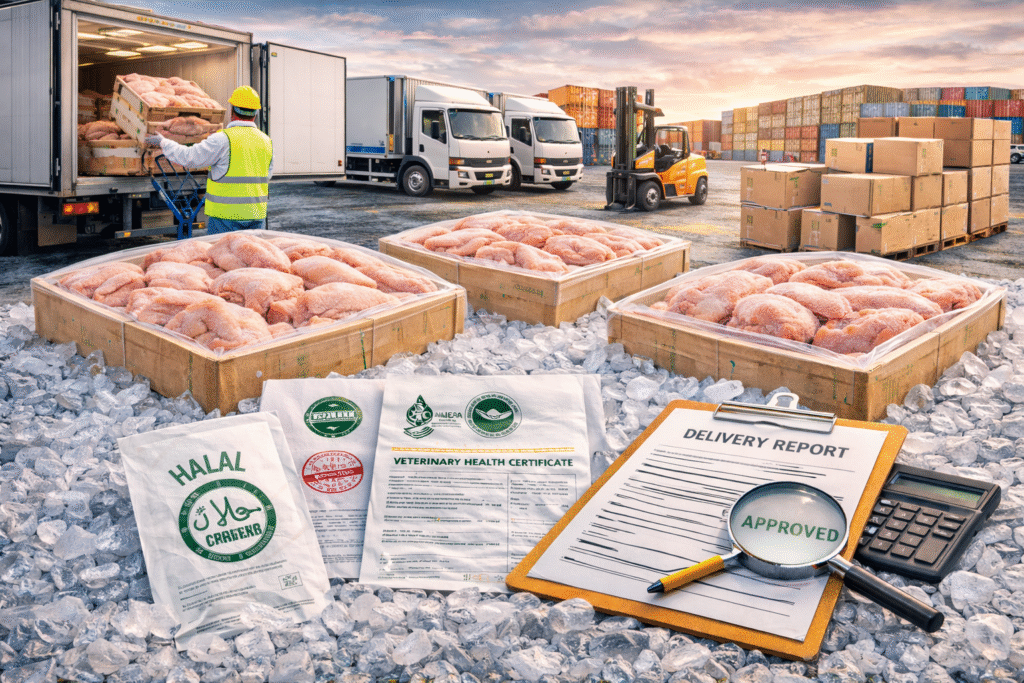
Introduction: Why the Poultry Distribution Business Is Expanding Globally
The poultry distribution business is becoming one of the most stable and scalable sectors in global food trade. As demand for affordable protein continues to rise, distributors serve as the crucial link between international exporters and local markets.
In many countries, distributors purchase frozen chicken through poultry export contracts and supply:
-
Wholesalers
-
Supermarkets
-
Restaurants
-
Catering companies
-
Institutional buyers
With growing urban populations and expanding cold storage infrastructure, poultry distribution offers significant long-term opportunity.
This article explains how the poultry distribution business works, what systems are required, and how to build a profitable model in 2026.
What Is a Poultry Distribution Business?
A poultry distribution business purchases chicken products in bulk from exporters or importers and distributes them within regional or national markets.
Most distributors focus on frozen products due to longer shelf life and easier logistics.
Core responsibilities include:
-
Bulk purchasing
-
Cold storage management
-
Inventory control
-
Transport logistics
-
Retail and wholesale sales
-
Regulatory compliance
Successful distributors combine supply chain efficiency with strong local market networks.
Why Frozen Poultry Dominates Distribution
The majority of distribution operations focus on frozen chicken because it offers:
1. Extended Shelf Life
Frozen poultry stored at -18°C can last up to 12 months.
2. Reduced Waste
Lower spoilage improves profitability.
3. Flexible Sales Timing
Distributors can release stock based on market demand.
4. Easier Transportation
Refrigerated trucks simplify regional distribution.
For these reasons, frozen chicken wholesale forms the foundation of most poultry distribution businesses.
Sourcing Products for Distribution
Distributors typically source from:
-
International chicken exporters
-
Brazil meat exporters
-
Large-scale chicken suppliers
-
Domestic importers
Brazil chicken exporters are often preferred due to:
-
Competitive pricing
-
Halal certification capability
-
Large production capacity
-
Consistent quality control
Long-term supply agreements provide price stability and guaranteed volume.
Popular Products in Poultry Distribution
Distributors commonly sell:
-
Chicken leg quarters
-
Chicken wings
-
Chicken breast fillets
-
Chicken paws
-
Mechanically deboned meat (MDM)
In price-sensitive markets, leg quarters remain the highest-volume product.
Infrastructure Requirements for a Poultry Distribution Business
To operate successfully, distributors need:
1. Cold Storage Facilities
Maintaining -18°C is critical for frozen poultry.
2. Refrigerated Transport
Temperature-controlled trucks ensure safe delivery.
3. Inventory Management System
Digital systems help track stock levels and expiration dates.
4. Compliance Documentation
Distributors must retain import certificates and health documents.
Strong infrastructure protects product integrity and reduces losses.
Pricing Model in Poultry Distribution
Understanding cost structure is essential.
| Cost Component | Impact |
|---|---|
| Purchase price (FOB/CIF) | High |
| Cold storage cost | Medium |
| Transport cost | Medium |
| Import duties | Medium |
| Currency exchange | Medium |
Profit margins depend on efficient inventory turnover and stable supply contracts.
Regulatory Compliance in Poultry Distribution
Distributors must comply with:
-
Food safety regulations
-
Veterinary import requirements
-
Halal certification (if applicable)
-
Cold chain standards
Non-compliance can result in fines or product seizure.
Risks in the Poultry Distribution Business
Although stable, risks include:
-
Port congestion delays
-
Currency fluctuations
-
Supply disruptions due to disease outbreaks
-
Fuel cost increases
-
Regulatory changes
Diversifying suppliers and maintaining buffer inventory reduces exposure.
Growth Opportunities in 2026
The poultry distribution business continues to grow due to:
-
Expanding urban markets
-
Increased restaurant demand
-
Government food security programs
-
Rising demand for halal poultry
-
Growing frozen chicken wholesale networks
Emerging markets in Africa and Southeast Asia show particularly strong growth potential.
How to Scale a Poultry Distribution Business
To expand operations:
-
Secure long-term agreements with reliable chicken exporters.
-
Invest in larger cold storage capacity.
-
Expand regional distribution networks.
-
Diversify product range.
-
Implement digital inventory tracking systems.
Strong supplier relationships—especially with established brazil meat exporters—support sustainable growth.
Future Outlook
Global protein consumption is expected to increase steadily through 2030. Poultry remains the most affordable and widely accepted protein source.
As poultry export markets expand, distributors will remain central to ensuring product availability at local levels.
Businesses that prioritize compliance, logistics efficiency, and supplier partnerships will dominate in 2026 and beyond.
Conclusion
The poultry distribution business offers a scalable and resilient opportunity in global food trade. With proper infrastructure, strong sourcing strategies, and efficient cold chain management, distributors can build long-term profitability.
By partnering with certified chicken suppliers and trusted poultry exporters, businesses can secure stable supply and meet growing consumer demand worldwide.
 Spanish
  English