
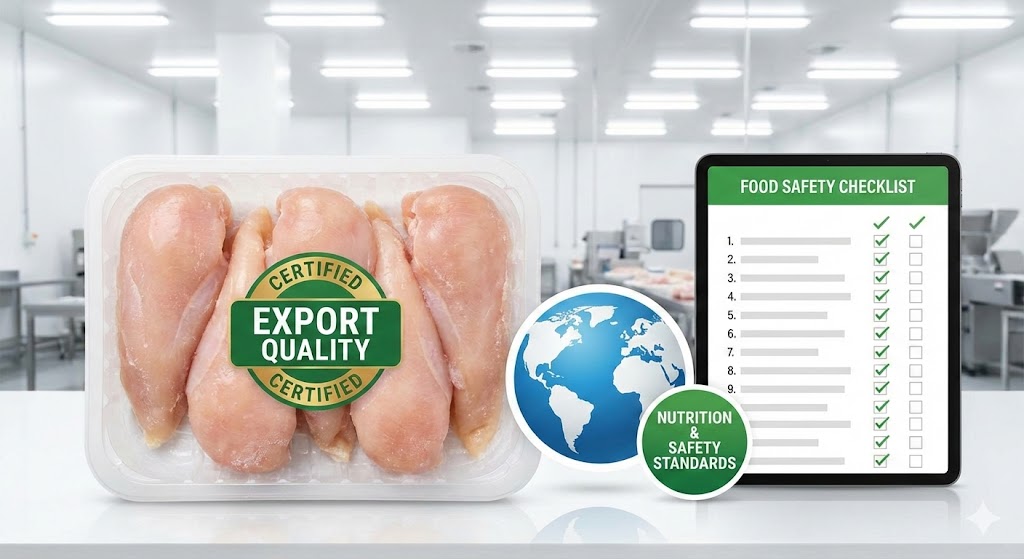
The modern global consumer is changing. They are no longer just asking “How much does it cost?”; instead, they are asking “Is this good for me?” The demand for Healthy Meat Exports is rising, driven by a growing awareness of nutrition and food safety. Consequently, for exporters and importers, the definition of “quality” has expanded to include nutritional integrity and the absence of harmful residues.
Contrary to old myths, imported frozen meat—especially chicken—often sets the benchmark for health standards. Because global trade requires adherence to the strictest international regulations, Healthy Meat Exports frequently undergo more rigorous testing than products sold in local domestic markets.
1. Nutritional Integrity: The Power of Flash Freezing
A common misconception is that “fresh” meat is nutritionally superior to frozen. However, in the context of global trade, the opposite is often true.
Locking in Nutrients
Time is the enemy of nutrition. “Fresh” meat sitting in a display case for days slowly degrades. In contrast, high-quality export meat undergoes flash freezing (often within hours of processing).
-
Protein Retention: Rapid freezing preserves the cellular structure of chicken and beef, ensuring that essential amino acids remain intact.
-
Micronutrients: Vitamins such as B12, Iron, and Zinc are locked in at their peak. Therefore, when the consumer thaws the product, the nutritional profile is virtually identical to the moment of slaughter.
To understand the mechanics of this preservation, read our deep dive on the Meat Export Freezing Process.
2. Safety Standards: The Foundation of Healthy Meat
You cannot have “healthy” meat if it isn’t safe. Healthy Meat Exports are defined by what is not in them as much as what is.
Antibiotic and Hormone Control
The global trend is moving aggressively toward “clean label” meat.
-
MRLs (Maximum Residue Limits): Major importing regions like the EU and Japan have extremely low tolerances for veterinary drug residues. Consequently, exporters must implement strict withdrawal periods and testing protocols to ensure their chicken and beef are free from harmful antibiotic levels.
-
Hormone-Free Beef: Many markets strictly prohibit growth hormones. Thus, exporters targeting these regions provide a product that is naturally grown, appealing to health-conscious consumers worried about synthetic additives.
Pathogen Reduction
Export standards for pathogens (like Salmonella and Campylobacter) are often stricter than domestic rules. For example, chicken destined for export often goes through rigorous microbiological testing protocols to ensure it is safe for consumption. This means the “Healthy Meat Export” is statistically less likely to carry foodborne illness risks.
3. The Role of Certifications in Health Assurance
How does a buyer know the meat is healthy? Certifications act as the guarantee.
HACCP and ISO 22000
These are not just bureaucratic badges; they are health management systems. They ensure that physical, chemical, and biological hazards are controlled. When a consumer sees these certifications, they know the processing environment was sanitary.
Halal and Kosher as Hygiene Standards
While primarily religious certifications, Halal and Kosher standards mandate rigorous animal health checks and blood drainage. As a result, many non-religious health-conscious consumers prefer these products because they perceive them as cleaner and more ethically processed.
4. Chicken: The Global Driver of Healthy Trade
While beef and pork have their markets, chicken remains the king of Healthy Meat Exports.
-
Lean Protein: Boneless, skinless chicken breast is the global standard for low-fat, high-protein nutrition.
-
Versatility: It is the primary protein used in health-focused meal prep, hospital catering, and weight-management diets worldwide.
-
Affordability: It democratizes nutrition, allowing developing nations to access high-quality protein that supports public health (Source: FAO Meat Market Review).
Setting the Standard for Global Health
Healthy Meat Exports are not a niche; they are the future of the industry. By combining advanced freezing technology to lock in nutrition with rigorous safety testing to keep out contaminants, the export market delivers a product that supports a healthy lifestyle.
For importers, sourcing verified, high-standard frozen meat is the best way to promise their customers that the food on their plate is as good for their bodies as it is for their taste buds.
 Spanish
  English