
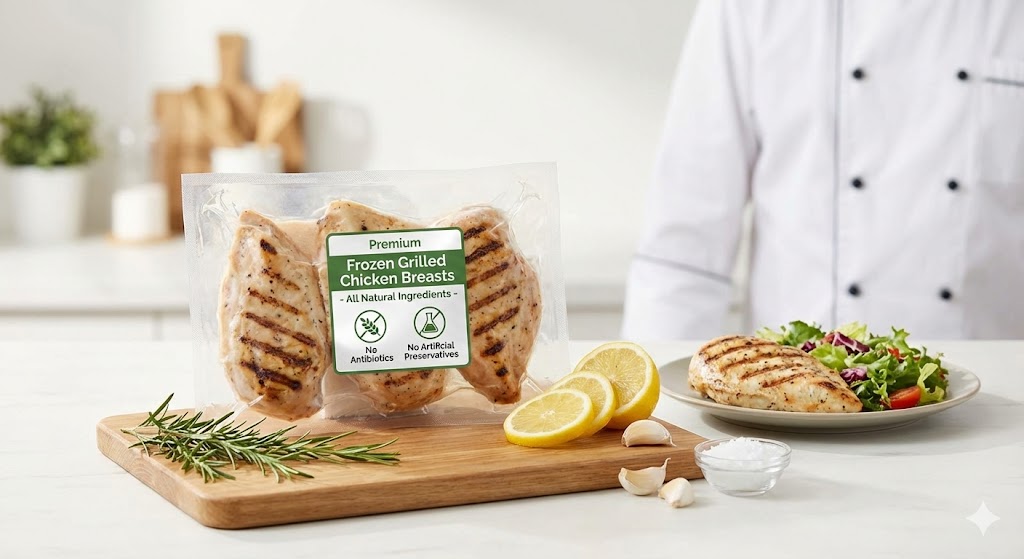
The global food industry is currently undergoing a “Clean Label” revolution. As we move through 2026, consumers are no longer just looking for convenience; they are scrutinizing ingredient lists for additives, preservatives, and artificial flavorings. For B2B importers and food service providers, this shift has transformed the way we source value-added proteins. Specifically, frozen grilled chicken has emerged as the front-runner in the “Healthy Convenience” category, offering a bridge between high-speed food service and the transparent nutrition today’s market demands.
At GlobalExporter-BR, we have seen the evolution of this product firsthand. What was once a basic processed item has become a highly sophisticated culinary solution. Our Brazilian facilities are now pioneering techniques that deliver flame-grilled flavor without the need for chemical enhancers. To understand our broader commitment to transparency and sustainable agricultural exports, you can visit our official profile on Medium.
Alt Text: Clean label frozen grilled chicken served in a healthy nutritious meal bowl.
1. What “Clean Label” Means for Frozen Grilled Chicken
For the professional procurement officer, “Clean Label” is not just a marketing buzzword; it is a technical specification. In the context of frozen grilled chicken, it refers to three core pillars:
-
Transparency: A short, recognizable list of ingredients (Chicken, Salt, Spices).
-
No Artificial Additives: The removal of phosphates, nitrites, and artificial “smoke” flavorings.
-
Minimal Processing: Using mechanical means (like vacuum tumbling) rather than chemical means to achieve tenderness.
The Science of Additive-Free Tenderness
Traditionally, processed chicken used phosphates to retain moisture. In 2026, premium frozen grilled chicken from Brazil utilizes salt-and-citrus marination techniques and precise steam-convection cooking to maintain a high yield without compromising the label’s “clean” status. This ensures that the final product remains juicy even after being reheated in a commercial kitchen.
Alt Text: Industrial steam-convection grilling process for clean label frozen grilled chicken.
2. Market Drivers: Why 2026 is the Year of Grilled Poultry
The shift toward frozen grilled chicken is driven by more than just health trends. It is a response to the economic realities of the modern food service sector.
Solving the Labor and Energy Crisis
Grilling raw chicken in a restaurant environment is labor-intensive and energy-heavy. By sourcing pre-cooked frozen grilled chicken, businesses can:
-
Reduce Energy Costs: The intensive “first cook” happens in Brazil using high-efficiency biomass-powered industrial grills.
-
Eliminate Prep Labor: No more trimming, marinating, or monitoring raw meat.
-
Guarantee Consistency: Whether in a franchise in London or a cafeteria in Riyadh, the flavor and texture of the premium chicken remain identical.
If you are currently evaluating your protein portfolio, it is helpful to look at how Chicken Prices are affecting the value of pre-cooked vs. raw items. Often, the labor savings of grilled products far outweigh the higher per-kilo acquisition cost.
3. The Brazilian Edge: Flame-Grilling at Scale
Brazil is uniquely positioned to dominate the frozen grilled chicken market because of its access to high-quality raw material. Because our birds are fed on a strictly controlled diet of corn and soy, the breast meat has a consistent density that is perfect for industrial grilling.
The “Maillard Reaction” without the Carbon
Achieving the perfect sear—the Maillard reaction—is what gives grilled chicken its appeal. Our facilities use real fire-grilling lines that create genuine char-marks. By using renewable energy sources for these lines, we provide a product that is “clean” for the body and “green” for the planet. To explore our full technical catalog of grilled cuts, visit our homepage.
Alt Text: Real flame-grilling production line for premium frozen grilled chicken in Brazil.
4. Quality Control: SIF and Halal Integrity
Maintaining a clean label doesn’t mean sacrificing safety. Every piece of frozen grilled chicken exported by GlobalExporter-BR is monitored by the SIF (Serviço de Inspeção Federal). This federal oversight ensures that the thermal process (the cooking) is sufficient to eliminate all pathogens, creating a product with a much safer profile than raw beef meat or fresh poultry.
Furthermore, our grilling lines are 100% Halal certified. We use only Halal-certified ingredients in our marinades, ensuring that our products meet the dietary requirements of the massive Middle Eastern and Southeast Asian “Healthy Halal” markets.
5. Logistics: Preserving the “Grilled” Experience
The challenge with frozen grilled chicken is preventing “Warmed-Over Flavor” (WOF), which can happen when fats oxidize. We solve this through:
-
Vacuum Skin Packaging (VSP): Removing all oxygen from the retail or bulk pack.
-
Individually Quick Frozen (IQF): Freezing the meat so quickly that ice crystals don’t rupture the cells.
-
Nitrogen Blanketing: Using inert gas during the packaging process to preserve the fresh-grilled aroma.
21 Frequently Asked Questions (FAQs) About Frozen Grilled Chicken
1. Is frozen grilled chicken fully cooked?
Yes, it is fully cooked to an internal temperature of at least 74°C (165°F), making it a “Heat and Serve” product.
2. What makes it “Clean Label”?
It contains no artificial preservatives, phosphates, or MSG. The ingredient list is short and consists of recognizable food items.
3. How do I reheat frozen grilled chicken without it getting dry?
The best results come from reheating in a convection oven or air fryer. Since it is already juicy from our marination process, only a short heating time is needed.
4. Can this product be used in cold applications?
Absolutely. Once thawed, frozen grilled chicken is excellent for salads, wraps, and sandwiches without any further cooking.
5. What cuts are available as grilled options?
The most common are breast fillets, thigh meat (boneless), strips, and diced cubes for industrial use.
6. Are the “grill marks” real or painted on?
In our premium lines, the grill marks are genuine, created by contact with a flame-grilling belt.
7. Does it contain allergens like gluten or soy?
We offer gluten-free and soy-free marinades. Always check the specific technical sheet for each SKU.
8. What is the shelf life in a commercial freezer?
Typically 12 to 18 months when maintained at a constant -18°C.
9. Why is the per-kilo price higher than raw chicken?
You are paying for the 100% yield (no cooking loss) and the labor/energy already expended in the cooking process.
10. Is the chicken Halal certified?
Yes, all frozen grilled chicken from GlobalExporter-BR is processed in Halal-certified facilities.
11. How is the product packaged for B2B export?
Usually in 1kg or 2kg IQF bags, packed into 10kg or 12kg master cartons.
12. Can I get custom flavors like Piri-Piri or Teriyaki?
Yes, for large volume contracts, we can develop custom “Clean Label” marinades for your brand.
13. How does the SIF seal apply to cooked products?
The SIF seal validates the cooking time and temperature logs, ensuring the product is 100% safe from a microbiological standpoint.
14. Is there a difference in nutrition between grilled and fried chicken?
Yes. Frozen grilled chicken is much lower in fat and calories as it is not breaded or submerged in oil.
15. What is the moisture retention strategy without phosphates?
We use a combination of natural starches (like potato or tapioca) and precise vacuum tumbling with salt.
16. Can I import mixed containers of grilled and raw chicken?
Yes, as long as both are frozen at -18°C, they can be shipped in the same reefer container.
17. Is Brazilian grilled chicken better than European options?
Brazil offers better price stability due to domestic grain supplies and massive scale, with identical (or superior) technology.
18. How do I verify the “Clean Label” claims?
We provide a full Ingredient Declaration and a Technical Specification sheet for every batch.
19. What is the Minimum Order Quantity (MOQ)?
Usually one 40ft container, though we can sometimes offer mixed loads for established partners.
20. Does freezing affect the “grill” flavor?
No. Using IQF technology and airtight packaging preserves the volatile flavor compounds of the grilling process.
21. How do I start a trial order?
Visit our contact page and request a technical sheet and pricing for our grilled poultry range.
 Spanish
  English