
Introduction
Understanding frozen chicken export logistics and pricing is critical for importers, distributors, and foodservice buyers sourcing poultry from major exporting countries like Brazil.
In 2025, rising fuel costs, port regulations, and cold-chain requirements mean buyers must clearly understand how frozen chicken is shipped, priced, and delivered to avoid delays and hidden costs.
This guide explains:
- Export logistics step-by-step
- Shipping methods and cold-chain requirements
- Pricing factors affecting frozen chicken exports
- How importers can reduce costs and risks
How Frozen Chicken Is Prepared for Export
Before shipping, frozen chicken undergoes strict export preparation.
Export Preparation Process:
- Halal or standard slaughter (as per market)
- Blast freezing at -35°C
- Storage at -18°C
- Quality inspection
- Packaging and labeling
- Container loading (reefer)
Maintaining temperature consistency is essential to preserve taste, texture, and shelf life.
Frozen Chicken Export Logistics Explained
Frozen chicken exports rely on cold-chain logistics, which ensure the product stays frozen from factory to destination port.
Key Logistics Stages:
- Cold storage at processing plant
- Transport to port in refrigerated trucks
- Loading into reefer containers
- Ocean freight shipment
- Customs clearance at destination
- Cold storage distribution
Any break in the cold chain can cause shipment rejection.
Reefer Containers & Temperature Control
Frozen chicken is shipped using refrigerated (reefer) containers.
Standard Reefer Settings:
- Temperature: -18°C
- Continuous monitoring
- Backup power systems
- Humidity control
Most exporters use 20ft or 40ft reefer containers, depending on order volume.
Export Documentation Required
Accurate documentation prevents customs delays.
Mandatory Documents:
- Commercial Invoice
- Packing List
- Bill of Lading
- Health Certificate
- Halal Certificate (if applicable)
- Certificate of Origin
Countries like Saudi Arabia, UAE, and Malaysia require strict halal and veterinary approvals.
Frozen Chicken Export Pricing: Key Factors
Frozen chicken export prices vary based on multiple factors.
Major Pricing Factors:
- Chicken cut type (whole, breast, leg quarters)
- Order volume
- Packaging requirements
- Destination country
- Freight rates
- Exchange rates
- Seasonal demand
Brazil Poultry Exports
Halal Frozen Chicken Exporter
Average Frozen Chicken Export Prices (Indicative)
| Product Type | Avg Price (USD/MT) |
|---|---|
| Whole Chicken | $1,100 – $1,500 |
| Leg Quarters | $900 – $1,300 |
| Chicken Breast | $2,000 – $2,600 |
| Wings | $1,600 – $2,100 |
Brazil remains one of the most cost-competitive exporters globally.
Incoterms Used in Poultry Exports
Understanding Incoterms helps avoid disputes.
Common Incoterms:
- FOB (Free on Board) – Buyer arranges freight
- CIF (Cost, Insurance & Freight) – Exporter arranges shipping
- CNF/CFR – Freight included, insurance excluded
Most new importers prefer CIF for simplicity.
Common Challenges in Frozen Chicken Imports
Importers should be aware of potential risks:
- Port congestion delays
- Documentation errors
- Temperature fluctuations
- Regulatory changes
- Currency volatility
Working with experienced exporters reduces these risks significantly.
How Importers Can Reduce Logistics Costs
Smart sourcing strategies include:
- Ordering full container loads (FCL)
- Long-term supply contracts
- Flexible shipping windows
- Choosing established export ports
- Working with certified exporters
Brazilian suppliers often offer better freight optimization due to scale.
Why Brazil Excels in Frozen Chicken Export Logistics
Brazil’s poultry export success comes from:
- Advanced port infrastructure
- High container availability
- Reliable cold-chain networks
- Strong government export support
- Experience shipping to 150+ countries
This makes Brazil a low-risk sourcing destination.
Future Trends in Frozen Chicken Logistics (2025+)
- Smart reefer tracking (IoT)
- Eco-friendly packaging
- Faster customs digitization
- Sustainable shipping practices
Exporters adopting these trends gain long-term buyer trust.
Frequently Asked Questions
How long does frozen chicken shipping take?
Typically 20–45 days depending on destination.
What is the shelf life of frozen chicken?
Up to 12 months at -18°C.
Is frozen chicken cheaper than fresh for export?
Yes, frozen chicken is more cost-effective and safer for long distances.
Conclusion
Mastering frozen chicken export logistics and pricing helps importers secure reliable supply, control costs, and avoid costly mistakes. With strong infrastructure, competitive pricing, and proven logistics expertise, Brazil continues to lead the global frozen poultry trade.
For buyers seeking consistency and scale, understanding logistics is just as important as product quality.
- Brazil Poultry Exports
- Halal Frozen Chicken Exporter
- Brazil Halal Chicken Export Industry
- FAO
- World Trade Organization (WTO)
- International Chamber of Commerce (Incoterms)
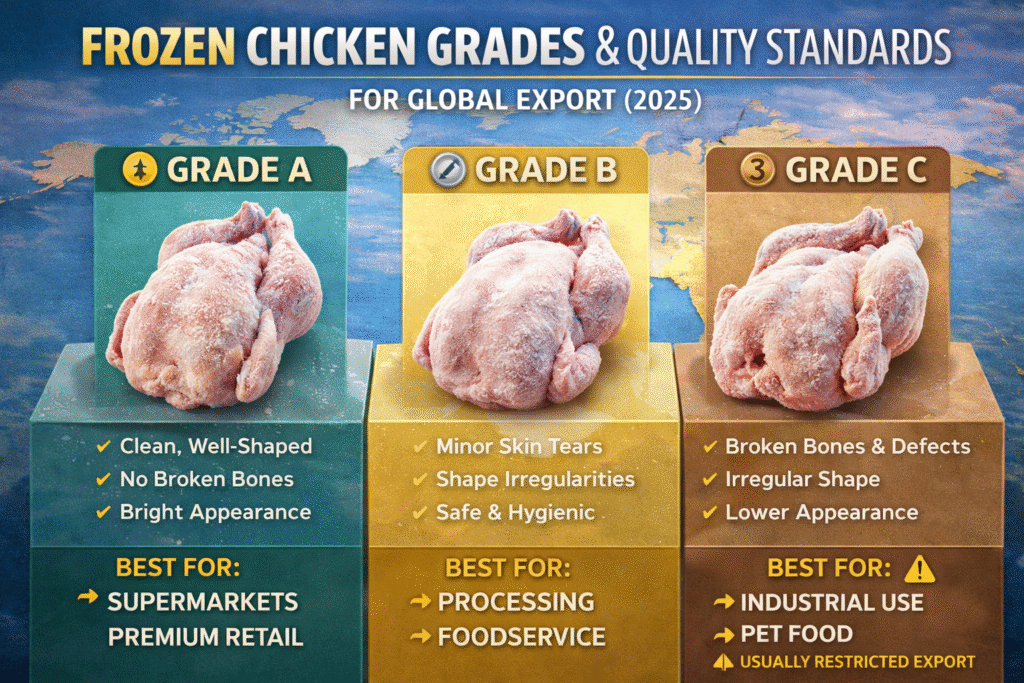
What Are Frozen Chicken Grades?
Frozen chicken grades classify poultry based on appearance, processing quality, and physical condition. These grades help buyers assess suitability for retail, foodservice, or further processing.
Grading systems may vary slightly by country, but the core quality principles remain universal.
Common Frozen Chicken Grades Used in Export
Grade A Frozen Chicken
Grade A is the highest quality and most demanded in international trade.
Characteristics:
-
Clean, well-shaped carcass
-
No broken bones
-
No discoloration or bruising
-
Minimal skin damage
-
Proper fat coverage
-
Uniform size and weight
Best For:
-
Supermarkets
-
Premium retail brands
-
Whole chicken sales
Grade B Frozen Chicken
Grade B chicken is acceptable for processing and foodservice use.
Characteristics:
-
Minor skin tears
-
Slight shape irregularities
-
No serious defects
-
Safe and hygienic
Best For:
-
Restaurants
-
Catering services
-
Further processing (cutting, marinating)
Grade C Frozen Chicken
Grade C is not suitable for premium retail, but still safe when approved for processing.
Characteristics:
-
Visible defects
-
Irregular shape
-
May include broken bones
-
Lower aesthetic quality
Best For:
-
Industrial processing
-
Pet food (depending on regulations)
-
Limited domestic use
⚠️ Grade C is usually restricted in exports and subject to country-specific rules.
Frozen Chicken Quality Standards for Export
Beyond grading, exporters must meet strict international quality standards.
Core Quality Requirements:
-
Free from diseases
-
No contamination
-
Proper bleeding
-
Correct freezing temperature
-
Hygienic processing
-
Approved veterinary inspection
Temperature & Freezing Standards
Proper freezing preserves chicken quality.
Global Export Standards:
-
Blast freezing at -35°C
-
Storage & shipping at -18°C
-
No thaw–refreeze cycles
-
Continuous temperature monitoring
Failure to maintain temperature can result in shipment rejection.
Moisture & Glazing Standards
Frozen chicken often includes protective glazing (ice layer).
Acceptable Glazing:
-
Usually 5%–10%
-
Prevents dehydration
-
Must be declared on packaging
Excessive glazing is considered quality manipulation and can damage exporter credibility.
Weight & Size Classification
Export buyers often specify exact weight ranges.
Common Weight Categories:
-
Whole chicken: 800g–900g, 900g–1000g, 1000g–1200g
-
Leg quarters: 300g–400g per piece
-
Breast fillets: 180g–220g per piece
Uniform sizing ensures pricing consistency and buyer satisfaction.
Packaging & Labeling Quality Standards
Export-grade packaging protects quality and meets regulations.
Packaging Requirements:
-
Food-grade inner bags
-
Strong export cartons
-
Clear labeling
-
Production & expiry dates
-
Halal logo (if applicable)
-
Country of origin
Halal Quality Standards (Where Applicable)
For halal markets, grading alone is not enough.
Halal Requirements Include:
-
Shariah-compliant slaughter
-
Muslim supervision
-
Halal-certified processing lines
-
Halal documentation
Brazil is globally recognized for high-grade halal frozen chicken exports.
Quality Inspections & Certifications
Export-grade frozen chicken is inspected by:
-
Government veterinary authorities
-
Independent inspectors
-
Halal certification bodies
-
Importing country regulators
Common Certifications:
-
HACCP
-
ISO 22000
-
BRC
-
Halal Certification
-
Health Certificate
How Importers Can Verify Frozen Chicken Quality
Smart buyers should:
-
Request product specifications
-
Ask for grading details
-
Verify certificates
-
Check packaging samples
-
Inspect temperature records
-
Work with experienced exporters
Quality verification reduces disputes and protects brand reputation.
Why Brazil Sets the Global Benchmark
Brazil leads frozen chicken exports because it offers:
-
Consistent Grade A supply
-
Large-scale production
-
Advanced inspection systems
-
Strong halal compliance
-
Competitive pricing
Brazilian poultry exporters are trusted across Middle East, Asia, Africa, and Europe.
Frequently Asked Questions (FAQ)
What is Grade A frozen chicken?
Grade A is the highest quality frozen chicken with no visible defects and excellent appearance.
Is Grade B chicken safe for consumption?
Yes, Grade B is safe and commonly used in foodservice and processing.
Can Grade C chicken be exported?
Usually restricted and depends on importing country regulations.
Conclusion
Understanding frozen chicken grades and quality standards helps importers make informed purchasing decisions, avoid disputes, and maintain consistent supply quality.
For exporters and buyers alike, proper grading, inspection, and certification are the foundation of successful poultry trade in 2025.
 Spanish
  English