
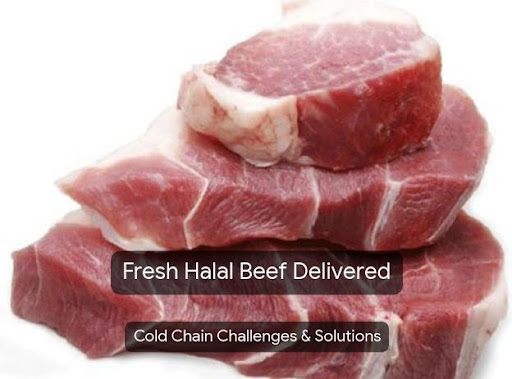
Fresh Halal Beef Delivered: Cold Chain Challenges & Solutions
Getting Fresh Halal Beef Delivered is not just about logistics; fundamentally, it is about maintaining a sacred trust. For millions of consumers worldwide, the “Halal” label serves as a non-negotiable guarantee of spiritual adherence, hygiene, and quality. However, unlike frozen meat, the process of getting Fresh Halal Beef Delivered presents a unique set of logistical nightmares. Specifically, it requires a flawless cold chain that balances strict temperature control with the religious mandate of absolute segregation from non-Halal products (Haram).
From the slaughterhouse to the butcher’s display, every step represents a potential failure point. This post explores the critical challenges of fresh Halal beef logistics. Furthermore, we analyze how top exporters and distributors utilize advanced strategies to ensure Fresh Halal Beef Delivered to the customer maintains its premium quality.
1. The Temperature Tightrope: Logistics for Fresh Halal Beef Delivered
The most immediate challenge exporters face when working to get Fresh Halal Beef Delivered is the unforgiving shelf life. While frozen beef can withstand minor temperature fluctuations, fresh beef acts as a ticking clock.
The “Chill” Zone
To successfully get Fresh Halal Beef Delivered in prime condition, logistics teams must maintain the meat strictly between 0°C and 4°C (32°F – 40°F).
-
Too warm (>4°C): Consequently, bacteria like Salmonella and E. coli multiply rapidly. This leads to spoilage and immediate food safety violations.
-
Too cold (<0°C): The meat begins to freeze. Ice crystals form and damage the muscle fibers. As a result, when the consumer prepares the meat, this leads to “drip loss”—a loss of moisture that ruins the texture and flavor. Ultimately, the customer will reject it as “not fresh.”
The Logistical Impact
This narrow window requires advanced refrigerated trucks (“reefers”) with precision cooling systems, rather than standard freezers. In addition, it demands faster transit times. Often, this necessitates air freight for international export, which significantly drives up costs compared to the sea freight used for frozen goods. (For a comparison on freezing technologies, see our guide on the Meat Export Freezing Process).
2. The Integrity Mandate: Zero Tolerance in Fresh Halal Beef Logistics
In standard cold chains, efficiency is king. Pallets of pork, beef, and alcohol often share the same shipping container or cold storage room to maximize space. However, when aiming to have Fresh Halal Beef Delivered compliantly, logistics providers must abandon this practice.
Absolute Segregation
The core of Halal integrity is protection from Najis (impurity). Therefore, Fresh Halal Beef Delivered to the market cannot come into direct contact—or even share the same air circulation space—with pork products or alcohol.
The “Mixed Load” Problem
Finding logistics partners who can guarantee a dedicated Halal supply chain remains difficult. A single mistake—such as loading Halal beef next to a pallet of bacon—renders the entire shipment non-Halal (Haram). To solve this, successful exporters use dedicated Halal-certified 3PL (Third-Party Logistics) providers. These partners use separate storage chambers and color-coded handling equipment. Thus, they ensure physical segregation is never breached.
3. Traceability: Ensuring Fresh Halal Beef Delivered is Authentic
Modern consumers don’t just trust the label; they verify it. To that end, technology plays a massive role in ensuring Fresh Halal Beef Delivered is genuine.
Digital Halal Certificates
Paper certificates are easily forged or lost. Consequently, the industry is moving toward blockchain-based traceability. Here, the Halal certificate travels digitally with the shipment, creating an immutable record of compliance.
Real-Time Monitoring
IoT (Internet of Things) sensors are now standard in high-value fresh beef shipments. These devices log the temperature and GPS location every few minutes. For example, if a truck door opens in a non-secure location or the temperature spikes, the distributor knows immediately. This allows them to intervene before the product is compromised. Organizations like the World Logistics Passport (WLP) are actively helping to streamline these high-standard trade flows.
Conclusion: The Cost of Excellence
Ultimately, having Fresh Halal Beef Delivered successfully is a premium service that commands a premium price. It requires a specialized infrastructure that prioritizes religious compliance and food safety over simple cost-cutting.
For importers and retailers, the lesson is clear: Cheap logistics are the most expensive mistake you can make. Instead, investing in a verified, segregated, and temperature-controlled cold chain is the only way to honor the Halal guarantee. By doing so, you ensure Fresh Halal Beef Delivered to your dock meets the high expectations of your customers.
 Spanish
  English