
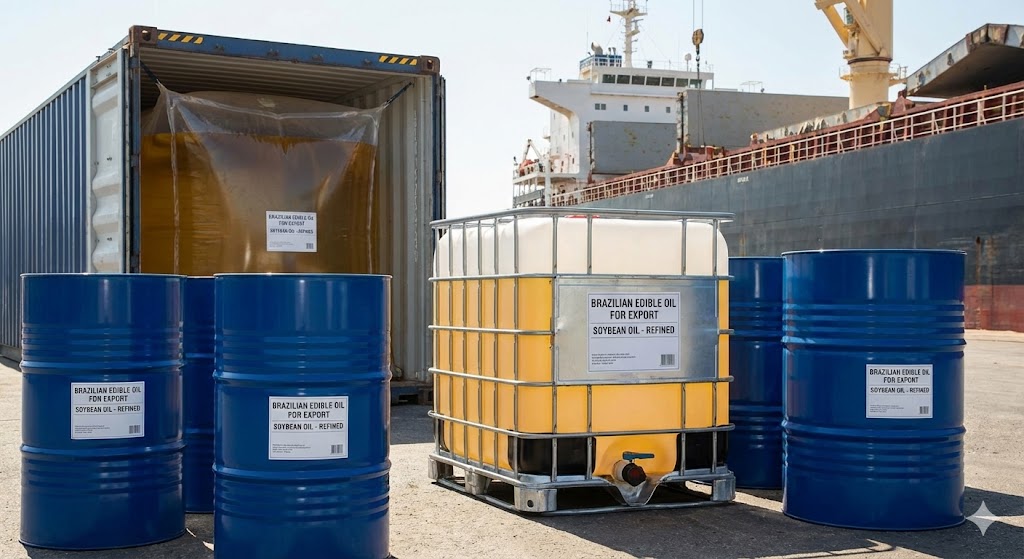
In the global food commodities market, the demand for high-quality edible oil is reaching record levels. As we look toward 2026, the intersection of food security, industrial manufacturing, and retail demand has placed a spotlight on Brazil as the world’s most reliable supplier. For international B2B importers, procurement officers, and wholesalers, understanding the dynamics of the Brazilian vegetable oil sector is essential for securing a stable and profitable supply chain.
At GlobalExporter-BR, we manage the complex logistics of moving liquid commodities across oceans. While many know us for our dominance in poultry and beef, our expertise in the edible oil sector—specifically soybean and sunflower oil—is a cornerstone of our service. To learn more about our commitment to agricultural excellence and global trade, you can visit our official profile on Medium.
Alt Text: High-quality edible soybean oil produced in Brazil for global bulk export.
1. The 2026 Global Landscape for Edible Oils
The global market for edible fats and oils is currently valued at billions of dollars, with a projected growth rate that shows no signs of slowing down. Several factors are driving this trend in 2026:
-
Population Growth: The rising global population, particularly in Asia and Africa, is increasing the base demand for cooking oils.
-
Industrial Food Processing: From snacks to ready-to-eat meals, vegetable oil is a primary ingredient in nearly every processed food category.
-
Biofuel Diversion: As the world moves toward green energy, a portion of the vegetable oil supply is being diverted to biodiesel, making the remaining edible supply more valuable.
Why Brazil is the World’s Oil Basin
Brazil is currently the largest producer and exporter of soybeans in the world. This massive agricultural output naturally feeds into a sophisticated crushing industry that produces high-grade edible soybean oil. By sourcing directly from a Global Exporter BR, you are tapping into a supply chain that is vertically integrated from the farm to the refinery. To explore our current bulk oil availability, visit our homepage.
2. Technical Specifications of Export-Grade Edible Oil
When importing edible oil in bulk, understanding the technical specifications is critical for ensuring compliance with your local food safety regulations.
Refined, Bleached, and Deodorized (RBD) Oil
The standard for international trade is RBD oil. This process ensures the oil is:
-
Neutral in Taste: It won’t interfere with the flavor of the food being cooked.
-
High Smoke Point: Essential for professional frying and high-heat cooking.
-
Long Shelf Life: The refining process removes impurities that cause oxidation and rancidity.
Alt Text: Technical quality control testing of refined edible soybean oil for international standards.
Fatty Acid Profiles and Nutrition
Modern consumers are increasingly health-conscious. Brazilian edible soybean oil is naturally low in saturated fats and contains essential Omega-3 and Omega-6 fatty acids. In 2026, we are also seeing a rise in demand for “Non-GMO” soybean oil, a niche that Brazil is uniquely positioned to fill through its segregated agricultural zones.
3. Logistics and Packaging: How We Ship Bulk Edible Oil
Shipping liquid gold across the ocean requires specialized packaging solutions. Depending on your volume and infrastructure, we offer several options for your edible oil shipment.
Flexitanks: The Modern Solution
For most B2B importers, the Flexitank is the most cost-effective method. A Flexitank is a large, flexible bladder that fits inside a standard 20ft shipping container, turning it into a 24,000-liter bulk liquid tank.
-
Benefit: Lower cost than traditional ISO tanks.
-
Hygiene: Each Flexitank is single-use, ensuring no cross-contamination from previous shipments.
Alt Text: Flexitank packaging used for bulk edible oil export from Brazil.
Intermediate Bulk Containers (IBC) and PET Bottles
For those who do not have bulk storage tanks at their destination, we provide:
-
IBC Totes (1,000 Liters): Perfect for medium-sized industrial processors.
-
Consumer-Ready PET (1L, 2L, 5L): Ready for the supermarket shelf, often under private labeling contracts.
4. Comparing Prices: Edible Oil vs. Protein Commodities
Strategic buyers often look at the “Bundle Potential” of their orders. In 2026, we are helping our partners optimize their freight by combining edible oil shipments with their orders for premium chicken or beef meat. While chicken prices might fluctuate based on bird health, vegetable oil prices are more closely tied to global grain harvests and energy markets.
5. Sustainability and ESG in the Oil Sector
The 2026 market demands transparency. Brazilian edible oil producers are increasingly adhering to the “Soy Moratorium” and other zero-deforestation initiatives. This ensures that the oil you import is not just high quality, but also ethically produced, allowing you to satisfy the ESG requirements of major retailers in Europe and North America.
21 Frequently Asked Questions (FAQs) About Edible Oil Export
1. What is the most common edible oil exported from Brazil?
Soybean oil is the primary edible oil export, followed by sunflower oil and specialized vegetable oil blends.
2. Is refined soybean oil better than crude oil for cooking?
Yes. Crude oil is mainly used for industrial purposes or biodiesel. Refined, Bleached, and Deodorized (RBD) oil is the standard for edible consumption.
3. What is the shelf life of bulk edible oil?
Refined oils typically have a shelf life of 12 to 24 months, provided they are stored in a cool, dark place away from moisture.
4. What are Flexitanks, and are they safe for food?
Flexitanks are single-use food-grade bladders that fit inside shipping containers. They are FDA and EU-approved for edible liquid transport.
5. Can I get private labeling for 1-liter oil bottles?
Yes, GlobalExporter-BR offers private labeling services for PET bottle shipments for large-volume retail contracts.
6. What is the smoke point of Brazilian refined soybean oil?
The smoke point is approximately 230°C (446°F), making it ideal for deep frying.
7. How does the price of edible oil relate to the price of soybeans?
The price of edible oil is directly correlated with the global price of raw soybeans and the “crush spread” (the cost of processing).
8. Does your oil contain GMOs?
While the majority of global soy is GMO, we can source certified Non-GMO edible oil for specific market requirements.
9. What is the Minimum Order Quantity (MOQ) for bulk oil?
The MOQ is typically one 20ft container using a Flexitank (approx. 20-22 metric tonnes).
10. Which Brazilian ports are used for oil export?
The Port of Paranaguá and the Port of Santos are the primary hubs for vegetable oil shipments.
11. Is edible oil Halal certified?
Yes. Vegetable oils are naturally Halal, but our refining and packaging processes are certified to ensure no cross-contamination.
12. How do you prevent oxidation during shipping?
We use nitrogen blanketing in some packaging and ensure that Flexitanks are filled properly to minimize the air gap (headspace).
13. What documents are required for importing oil?
Standard documents include the Bill of Lading, Commercial Invoice, Packing List, Health Certificate, and Certificate of Analysis.
14. Can I mix a container with oil and chicken?
Generally, no. Edible oil in Flexitanks or bottles is shipped at ambient temperatures, while chicken requires -18°C. They must be in separate containers.
15. What is the “Free Fatty Acid” (FFA) limit for edible oil?
Standard RBD soybean oil typically has an FFA level of less than 0.1%, ensuring maximum freshness.
16. Are there tariffs on Brazilian edible oil?
Tariffs depend on your country’s trade agreement with Brazil. You should check your local “Harmonized System” (HS Code) rates.
17. Why is Brazilian sunflower oil in high demand?
It is a premium edible oil known for its high Vitamin E content and heart-healthy fatty acid profile.
18. How do I verify the quality of a shipment?
Every shipment comes with a Laboratory Certificate of Analysis (COA) detailing the oil’s purity, color, and moisture levels.
19. Does GlobalExporter-BR offer crude degummed soybean oil?
Yes, we export crude degummed oil for industrial clients who have their own refining facilities.
20. How do energy prices affect edible oil costs?
Since oil is heavy and requires significant processing power, increases in fuel or electricity can lead to higher edible oil prices.
21. How do I get a quote for a bulk order?
Visit our contact page and provide your target volume and destination port for an immediate quote.
 Spanish
  English