
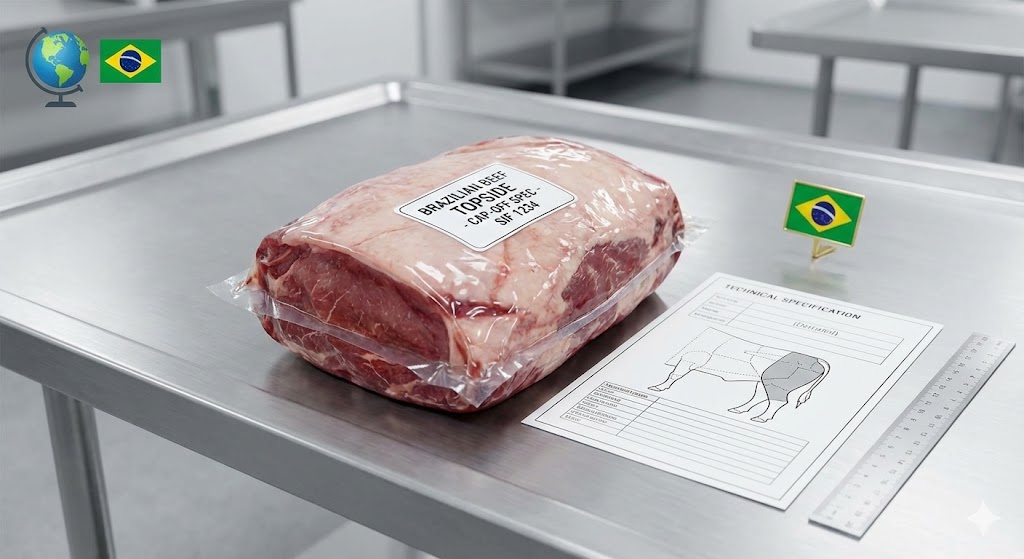
The beef topside—known in the Brazilian trade as the Coxão Mole—represents one of the most versatile and high-volume primals in the international beef market. As we move through 2026, global B2B buyers increasingly rely on this cut for its exceptional lean-to-fat ratio and uniform muscle structure. Because the topside serves as a primary source for roasting joints, lean steaks, and premium dicing meat, mastering its technical specifications is critical for maintaining high-yield retail operations. Consequently, Brazil has optimized its processing lines to deliver a highly standardized, SIF-certified product that satisfies the rigorous quality standards of both Europe and Asia.
At GlobalExporter-BR, we connect international procurement officers with Brazil’s most efficient and technologically advanced facilities. We understand that your profitability depends on the technical precision of the “Cap-off” or “Denuded” specifications. To learn more about our broader commitment to excellence in the global food supply chain, you can visit our official profile on Medium.
1. Anatomy and Performance
The beef topside originates from the Hindquarter, specifically the inner portion of the thigh. Unlike the Beef Rump, which consists of multiple muscle groups, the topside is essentially a single, large muscle block (semimembranosus).
Why the Topside is a Retail Favorite
Retailers prioritize the beef topside because of its remarkable consistency. Specifically, its large, lean surface area allows for easy portioning into uniform roasts or thin-sliced “minute steaks.” Furthermore, because it contains virtually no internal fat or “gristle,” it offers one of the highest usable yields of any beef primal. This makes it an ideal choice for the budget-conscious but quality-driven consumer segments of 2026. Consequently, it remains a staple for both supermarket counters and high-volume catering services.
2. Technical Export Specifications (The Trim)
Brazilian packers offer the beef topside in several standardized trim levels. Your choice of specification determines your final “plate-cost” and the amount of secondary labor required.
Standard Topside (Cap-On)
In this configuration, the packer leaves the external fat layer and the “cap” muscle attached. Consequently, the price per kilo is lower. Nevertheless, the buyer must account for the weight lost when removing the external connective tissue at the destination.
Premium Topside (Cap-Off / Denuded)
This represents the gold standard for high-end export. The butcher removes the external fat and the tough silver skin (membrane). Specifically, the “Denuded” designation indicates that the butcher has fabricated the topside into a clean, ready-to-slice primal. Furthermore, we often calibrate these into weight ranges (e.g., 5kg-7kg) to ensure uniformity in your production lines. For a technical breakdown of how we measure the quality of these muscles, refer to our Beef Cuts Technical Guide.
3. The SIF and Safety Protocol
Because the beef topside is a massive, dense muscle, maintaining strict internal temperature control is paramount. Accordingly, the SIF (Serviço de Inspeção Federal) implements rigorous monitoring at every stage.
-
Rapid Chilling: Facilities must lower the internal temperature of the topside to below 4°C rapidly after slaughter. This prevents microbial growth in the deep tissue.
-
Traceability: Every carton carries a SIF stamp and a unique barcode. Consequently, you can trace the product back to the specific slaughter date and farm. Furthermore, we verify the pH levels of every batch to ensure it remains below 5.8, guaranteeing a bright cherry-red color and optimal shelf life.
4. 2026 Logistics: Maximizing Container Yield
Shipping beef topside internationally requires a “zero-compromise” cold chain strategy.
Frozen vs. Chilled
-
Frozen (Industrial and Retail): Most international shipments of beef topside travel as blast-frozen cargo. Because it is a lean cut, it withstands the freezing process exceptionally well. Specifically, our plants use tunnel freezers to reach a core temperature of -18°C within hours. This provides a 24-month shelf life.
-
Chilled (Premium Foodservice): Conversely, for markets requiring “fresh” roasting joints, we ship chilled vacuum-packed topsides. Similar to our Beef Striploin, these undergo “wet aging” during the 35-day sea voyage. Consequently, the meat becomes more tender and flavorful by the time it reaches your warehouse.
21 Frequently Asked Questions (FAQs) About Beef Topside
1. What is the Brazilian name for Beef Topside?
In Brazil, the beef topside is known as Coxão Mole.
2. Is the topside a tender cut?
It is a lean, medium-tender cut. Specifically, it is excellent for roasting or slow-cooking. If sliced thinly across the grain, it also makes excellent steaks.
3. What is the best culinary use for beef topside?
It is the world’s premier cut for traditional roast beef. Furthermore, it is ideal for biltong, jerky, and schnitzel.
4. What does “Cap-Off” mean for topside?
It means the butcher has removed the external layer of fat and the “cap” muscle, leaving a clean, lean block of meat.
5. Why is the topside called “Coxão Mole”?
The name translates to “Soft Thigh,” reflecting its status as the most tender muscle in the rear leg of the animal.
6. Are Brazilian beef topsides Halal certified?
Yes. GlobalExporter-BR sources exclusively from SIF-certified plants that maintain 100% Halal certification for international markets.
7. What is the typical weight of a Brazilian beef topside?
Export-grade topsides generally weigh between 5kg and 9kg, depending on the animal’s size.
8. How many roasting joints can I get from one topside?
A standard 7kg topside can be divided into 3 to 4 large, uniform roasting joints.
9. Why is the color of the topside so bright red?
The topside is a highly oxygenated muscle with low fat content, resulting in a vibrant cherry-red color when fresh.
10. Does the topside have a lot of connective tissue?
It has very little internal connective tissue. However, it does have a tough silver skin on the exterior that the butcher must remove.
11. What is the shelf life of frozen beef topside?
When maintained at -18°C, frozen beef topside has a shelf life of 24 months.
12. How do you prevent the meat from being tough?
Technicians must slice the topside against the grain. Furthermore, “wet aging” the product for 21+ days significantly improves tenderness.
13. What is the Minimum Order Quantity (MOQ)?
The standard MOQ is one 40ft reefer container (approx. 27-28 tonnes).
14. Can I request a specific weight range (Calibration)?
Yes. We can calibrate topsides into specific weight brackets (e.g., 6kg-7kg) for large-volume retail contracts.
15. Is Brazilian topside grass-fed or grain-fed?
We offer both. However, the grain-finished program improves the fat color and tenderness of the meat.
16. What is the difference between Topside and Silverside?
Topside is from the inner thigh and is more tender. Silverside (Coxão Duro) is from the outer thigh and is tougher, requiring slow cooking.
17. How is the product packaged for export?
Each topside is Individually Vacuum Packed (IVP), and then 3 to 5 pieces are placed in a master carton.
18. Does Brazil use growth hormones?
No. The use of growth hormones is strictly prohibited by Brazilian law and monitored by federal SIF inspectors.
19. How do you calculate the yield of a topside?
A “Denuded” or “Cap-off” topside provides nearly 100% usable yield for roasting or slicing.
20. How does the price compare to the Knuckle?
The beef topside is priced similarly to the Beef Knuckle, making it very cost-effective for retail.
21. How do I get a price quote for a bulk order?
Visit the contact page on GlobalExporter-BR and provide your destination port and required trim specification.
 Spanish
  English