
Sourcing high-quality beef tenderloin—known globally as Filé Mignon—represents the pinnacle of premium protein procurement. In the 2026 global market, professional buyers for high-end hospitality and retail sectors demand absolute precision in specifications. While this cut commands the highest price point per kilogram, its value depends entirely on the exactness of the trim and the consistency of the sizing. Consequently, understanding the technical fabrication of Brazilian beef tenderloin is essential for protecting your margins.
At GlobalExporter-BR, we specialize in connecting international buyers with Brazilian packers who master the art of premium fabrication. We ensure you receive the exact specs your clientele demands, whether you need raw material for center-cut steaks or fully trimmed roasts. To learn more about our broader commitment to excellence in the global food supply chain, you can visit our official profile on Medium.
Alt Text: Premium Brazilian beef tenderloin, fully trimmed and ready for B2B export.
1. The Anatomy of Tenderness
The beef tenderloin (Psoas Major muscle) holds a unique position in bovine anatomy. Located beneath the ribs and next to the backbone, this muscle performs almost no mechanical work during the animal’s life. Consequently, it develops virtually no connective tissue.
The “Melt-in-Your-Mouth” Texture
Because it lacks tough collagen, the beef tenderloin delivers an incredibly soft texture that chefs prize globally. Furthermore, it is exceptionally lean. Unlike the high-fat Brazilian Ribeye, the tenderloin relies on its fine grain structure rather than intramuscular fat for tenderness. This characteristic makes it the preferred choice for the health-conscious luxury consumer in 2026.
2. Technical Export Specifications (The Trim)
For the B2B buyer, specifying the “trim” level is the most critical part of the negotiation. Brazilian packers offer several standard configurations, each impacting your labor costs and final yield differently.
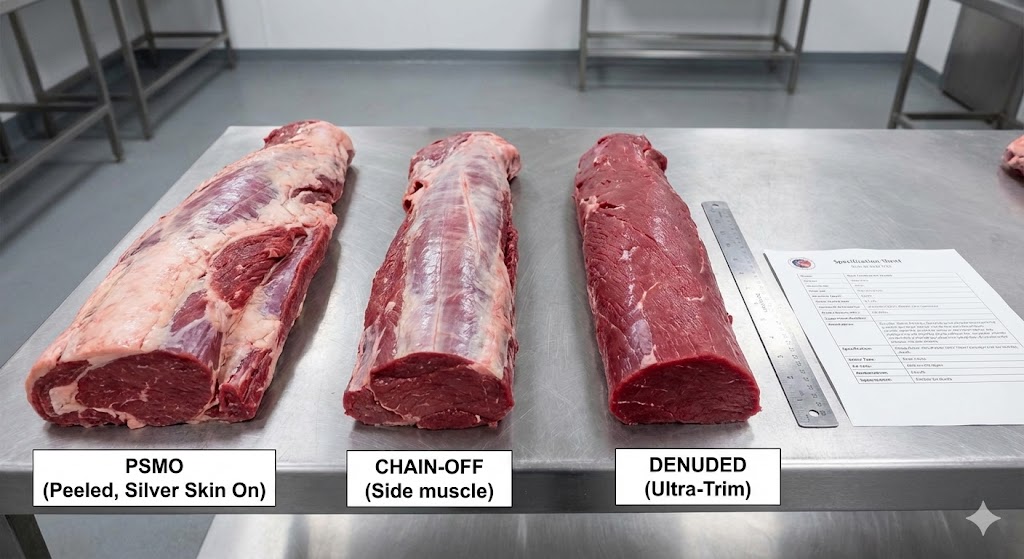
PSMO (Peeled, Silver Skin On, Side Muscle On)
This is the “packer cut.” The butcher removes the major fat deposits, but the “chain” (side muscle) and the tough “silver skin” remain attached. Therefore, this option offers a lower price per kilo but requires significant skilled labor at the destination to make it restaurant-ready.
Chain-Off (Semi-Trimmed)
In this popular export spec, the facility removes the fatty “chain” muscle running along the side. However, the silver skin remains. This specification balances purchase price with preparation time.
Denuded (Silver Skin Off / Ultra-Trim)
This represents the highest value-added specification. The packer removes all external fat, the chain, and the tough silver skin membrane. Consequently, the buyer receives 100% usable meat, ready for immediate portioning into Filé Mignon steaks. While the initial cost is higher, it eliminates trimmings waste at the destination.
Alt Text: Technical comparison of beef tenderloin trim specs: PSMO vs. Chain-Off vs. Denuded.
3. Sizing and Calibration Strategy
Because the tenderloin tapers from a thick “head” to a thin “tail,” uniformity is a challenge. Therefore, Brazilian exporters use precise weight calibration to assist buyers.
Common Weight Ranges
Packers typically sort whole beef tenderloins into the following ranges to ensure consistent steak sizing:
-
3/4 lbs (approx. 1.4kg – 1.8kg): Ideally suited for retail packaging.
-
4/5 lbs (approx. 1.8kg – 2.3kg): The standard foodservice size for cutting generous center-cut steaks.
-
5/up lbs (approx. 2.3kg+): Derived from larger animals, these are perfect for large roasting joints.
Furthermore, buyers should note that grain-finished Angus cattle generally produce larger, thicker tenderloins compared to grass-fed Nelore breeds.
4. The SIF and Quality Assurance Protocol
Due to its low fat content, beef tenderloin is highly sensitive to temperature fluctuations and handling. Accordingly, the SIF (Serviço de Inspeção Federal) implements strict protocols for this high-value cut.
-
Microbiological Control: Because processors often serve tenderloin rare or medium-rare, SIF inspectors conduct rigorous pathogen testing on these lines.
-
pH Testing: Inspectors test carcasses to ensure a pH below 5.8. High pH meat (“dark cutters”) appears unappealing and has a shorter shelf life; therefore, packers exclude it from premium tenderloin boxes.
For a deeper dive into how Brazil maintains quality across different products, explore our Beef Cuts Technical Guide.
5. 2026 Logistics: Chilled vs. Frozen
The logistics strategy for beef tenderloin depends heavily on the target market’s distance and culinary preferences.
Chilled (High-End Hospitality)
For premium steakhouses in Europe and the Middle East, we primarily ship chilled, vacuum-packed tenderloins. Maintaining the temperature strictly between -1.5°C and -0.5°C allows the meat to “wet age” during the 30-40 day ocean transit. Consequently, the product arrives even more tender than on the day of processing.
Frozen (Retail and Industrial)
Conversely, for markets requiring longer shelf life or lower price points, blast-frozen tenderloin is the standard. High-quality Individual Quick Freezing (IQF) tunnels ensure ice crystals remain small, thus preserving the meat’s cellular structure upon thawing.
Alt Text: SIF sanitary inspection of vacuum-packed Brazilian beef tenderloin for export.
21 Frequently Asked Questions (FAQs) About Beef Tenderloin
1. What is the difference between Beef Tenderloin and Filé Mignon?
The beef tenderloin is the entire sub-primal muscle. Filé Mignon specifically refers to the steaks cut from the narrower “tail” end of that muscle.
2. Why is tenderloin the most expensive cut?
It is the most tender muscle on the animal, yet it comprises only about 2-3% of the total carcass weight. This scarcity drives the price.
3. What is “Silver Skin”?
Silver skin is a tough layer of connective tissue (elastin) attached to the muscle. You must remove it before cooking because it does not break down under heat.
4. Does Brazilian tenderloin have marbling?
Generally, tenderloin is a lean cut. However, grain-finished Brazilian Angus tenderloins exhibit moderate intramuscular fat, enhancing flavor.
5. What is the “Chain” muscle?
The chain is a fatty, narrow strip of meat running along the side of the main tenderloin. Butchers usually remove it for premium specs.
6. Are these products Halal certified?
Yes, GlobalExporter-BR exclusively sources from plants that maintain full Halal certification with accredited bodies like FAMBRAS.
7. What does “PSMO” stand for?
It stands for Peeled, Silver skin On, and Side Muscle (chain) On. It is the least trimmed specification.
8. How many steaks can you get from one whole tenderloin?
Depending on thickness, a 2kg whole tenderloin typically yields 6 to 8 premium center-cut steaks.
9. Why do some tenderloins look dark?
A dark color usually indicates a “dark cutter” (high pH meat caused by pre-slaughter stress) or temperature abuse. SIF inspectors should reject these.
10. Is grass-fed tenderloin better than grain-fed?
Grass-fed is leaner with a more robust flavor. Conversely, grain-fed is richer and milder. The choice depends on market preference.
11. What is the shelf life of chilled vacuum-packed tenderloin?
Under optimal conditions (-1.5°C), chilled tenderloin maintains quality for 90 to 120 days.
12. How are they packaged for export?
Packers individually vacuum-pack (IVP) each piece and place them in 15kg to 20kg master cartons.
13. Can I buy only the “Center Cut” (Chateaubriand)?
Yes, some specialized plants offer portion-controlled center cuts, though this significantly increases the price per kilo.
14. What is the minimum order quantity (MOQ)?
Typically, the MOQ is one 20ft or 40ft reefer container. However, we can sometimes arrange mixed loads with other high-value cuts.
15. How do you ensure sizing consistency?
Modern Brazilian plants use automated weight grading systems to sort tenderloins into precise calibration ranges.
16. Do you export “utility grade” tenderloins?
We focus on premium Grade A export quality. However, we can source “no-roll” or ungraded options for industrial processing clients upon request.
17. Why is the head thick and the tail thin?
This is the natural anatomical shape of the Psoas Major muscle as it sits against the bovine spine.
18. Does freezing ruin a tenderloin?
Not if done correctly. Rapid blast-freezing preserves quality. However, slow freezing causes large ice crystals that damage texture.
19. Can I request private labeling?
Yes, we offer private labeling options on the individual vacuum packs and master cartons for long-term partners.
20. How does Brazil’s price compare to US or Australian tenderloin?
Brazil generally offers a highly competitive price point for excellent quality, especially for grain-finished programs that rival international standards.
21. How do I get a current price quote?
Visit the contact page on GlobalExporter-BR and specify your required trim level, calibration, and destination port.
 Spanish
  English