
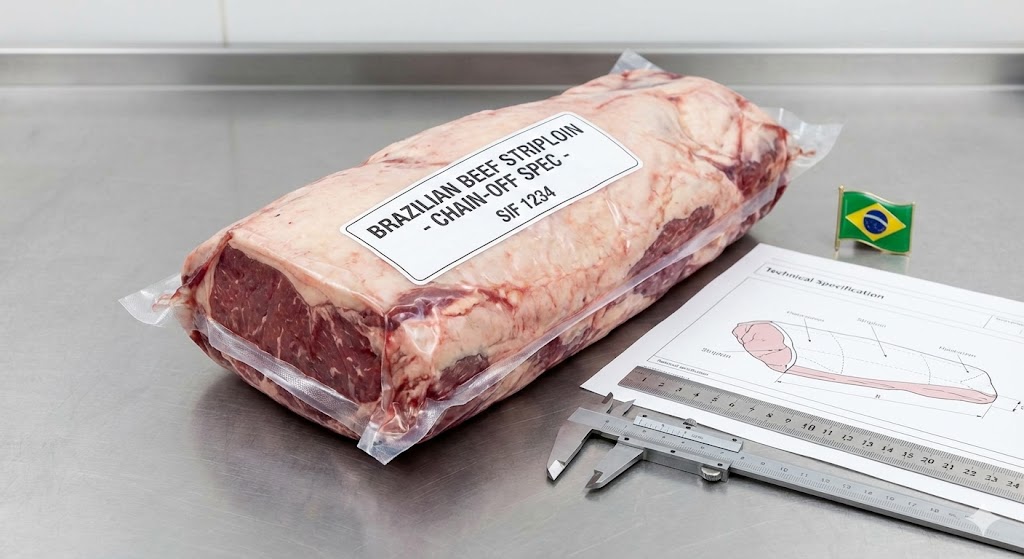
Procuring high-quality beef striploin—the muscle behind the world-famous New York Strip steak—represents a strategic priority for premium retailers and steakhouses. In the 2026 global market, Brazil has emerged as a dominant supplier by offering a perfect balance between massive production scale and artisanal precision in butchery. Because this cut offers a superior balance of tenderness and robust flavor, it remains the primary driver of revenue in the center-of-the-plate category. Consequently, understanding the technical specifications of Brazilian beef striploin is essential for any professional procurement officer.
At GlobalExporter-BR, we bridge the gap between Brazil’s advanced cattle programs and the exacting needs of international B2B partners. We ensure that every shipment meets your specific requirements for fat cover, weight, and genetic origin. To learn more about our commitment to excellence in the global food supply chain, you can visit our official profile on Medium.
Alt Text: Premium Brazilian beef striploin primal, vacuum-packed for B2B export.
1. Anatomy and Flavor Profile
The beef striploin originates from the Short Loin primal, specifically the Longissimus dorsi muscle. Unlike the Beef Tenderloin, which sits inside the rib cage, the striploin sits along the exterior of the spine.
Why Chefs Prefer the Striploin
Chefs value the striploin because it offers a tighter grain than the Brazilian Ribeye while retaining significant flavor. Specifically, the fat cap (subcutaneous fat) provides a protective barrier during high-heat cooking. As the fat renders, it bastes the meat, resulting in the iconic “beefy” aroma that diners associate with a premium steakhouse experience. Furthermore, the striploin is more economical than the tenderloin, allowing for better plate-cost management.
Alt Text: Technical diagram showing the anatomical position of the beef striploin on a carcass.
2. Technical Export Specifications (The Trim)
Brazilian packers offer several standardized trim levels for beef striploin. Your choice of “spec” directly impacts your final yield and in-house labor requirements.
Standard Trim (Chain-On)
In this configuration, the packer leaves the “chain”—a strip of fat and connective tissue—attached to the side of the loin. Consequently, the price per kilo is lower, but the buyer must perform additional trimming at the destination.
Premium Trim (Chain-Off / 0x0)
This represents the gold standard for high-end export. The butcher removes the side chain and trims the external fat cap to a uniform thickness (usually 0.5cm to 1cm). Specifically, the “0x0” designation indicates that the butcher has removed all “tail” fat and bone-side tissue. Therefore, you receive a clean, ready-to-slice primal that maximizes kitchen efficiency.
Marbling and Grading
In 2026, Brazilian beef striploin is graded based on intramuscular fat (IMF). While grass-fed options remain popular for health-focused retail, grain-finished Angus programs deliver the “Choice” and “Prime” equivalent marbling that international markets demand. For a technical breakdown of how we measure this fat, refer to our Beef Marbling Guide.
3. The SIF and Safety Protocol
Because the beef striploin is a high-surface-area cut, maintaining sanitary integrity is paramount. Accordingly, the SIF (Serviço de Inspeção Federal) oversees every stage of fabrication.
-
Cold Chain Integrity: Facilities must chill the loins to an internal temperature of 0°C to 2°C within 24 hours of slaughter. This prevents bacterial growth and preserves the bright cherry-red color.
-
Traceability: Every carton of beef striploin carries a SIF stamp and a barcode. Consequently, you can trace the product back to the specific farm and processing date.
4. Logistics: Wet Aging for Tenderness
Most premium beef striploin shipments from Brazil travel as chilled (never frozen) cargo. This strategy leverages the transit time to improve the product’s quality.
The Wet Aging Process
We seal the loins in high-barrier vacuum bags and store them in reefer containers at -1°C. During the 30-to-40-day voyage to Europe or Asia, natural enzymes break down the muscle fibers. Nevertheless, the vacuum environment prevents spoilage. This “wet aging” ensures that the product arriving at your warehouse is significantly more tender than the day it left the plant.
Alt Text: Logistics of exporting chilled Brazilian beef striploin in refrigerated containers.
21 Frequently Asked Questions (FAQs) About Beef Striploin
1. What is the difference between a Striploin and a New York Strip?
The beef striploin is the whole sub-primal muscle. The “New York Strip” is the individual steak sliced from that sub-primal.
2. Why is there a fat cap on the striploin?
The fat cap protects the meat from drying out during cooking and provides the essential flavor and aroma associated with the cut.
3. What does “Chain-Off” mean?
It means the butcher has removed the thin, fatty side muscle (the chain) from the loin, leaving only the primary steak muscle.
4. Is Brazilian striploin grass-fed?
Brazil produces both. However, the premium export grade is usually “grain-finished” for 120-150 days to improve marbling and fat color.
5. What is the “0x0” specification?
This is a technical term indicating a highly trimmed loin with no excess fat on the edges and no tail, providing maximum yield.
6. Are these products Halal certified?
Yes. GlobalExporter-BR partners exclusively with SIF plants that maintain full Halal certification for international markets.
7. How many steaks can I cut from a whole striploin?
A standard 4kg to 5kg beef striploin primal typically yields 12 to 16 thick-cut New York Strip steaks.
8. What is the shelf life of chilled vacuum-packed striploin?
If maintained at -1°C, chilled vacuum-packed striploin has a shelf life of approximately 90 to 120 days.
9. Why is the color of the fat white instead of yellow?
White fat indicates grain-finished cattle. Conversely, yellow fat often indicates older animals or an exclusively grass-fed diet.
10. Does the striploin have more flavor than the tenderloin?
Yes. Because the striploin has more intramuscular fat and a tighter grain, most experts consider it more flavorful than the leaner tenderloin.
11. What is “Wet Aging”?
It is the process of aging meat in a vacuum-sealed bag at low temperatures, allowing enzymes to tenderize the meat without moisture loss.
12. How do you prevent “Dark Cutters”?
SIF inspectors test the pH of the carcass. Any loin with a pH above 5.8 is excluded from the premium export chain.
13. What is the average weight of a Brazilian striploin primal?
Export-grade primals generally weigh between 4kg and 6kg, depending on the breed and age of the animal.
14. Can I buy frozen striploin?
Yes. While chilled is the premium standard, we offer blast-frozen options for markets requiring longer shelf stability.
15. What is the difference between Angus and Nelore striploin?
Angus cattle generally deposit more marbling. Nelore cattle produce leaner meat with a more robust “beefy” flavor profile.
16. How is the product packaged for B2B?
Each loin is Individually Vacuum Packed (IVP). Then, 3 to 5 loins are placed in a heavy-duty cardboard master carton.
17. What is the Minimum Order Quantity (MOQ)?
The standard MOQ is one 20ft or 40ft reefer container (approx. 27 tonnes). Mixed loads are available for established partners.
18. Does Brazil use growth hormones?
No. The use of growth hormones in cattle is strictly prohibited by Brazilian federal law and monitored by the SIF.
19. Can I request a specific fat cap thickness?
Yes. We can specify fat trim levels (e.g., “max 1cm fat cap”) in the procurement contract to meet your market needs.
20. How do I know the age of the animal?
Export-grade beef is typically harvested from cattle under 30 months old, which ensures tenderness and bright meat color.
21. How do I get a price quote for a bulk order?
Visit the contact page on GlobalExporter-BR and provide your target weight spec, trim level, and port of destination.
 Spanish
  English