
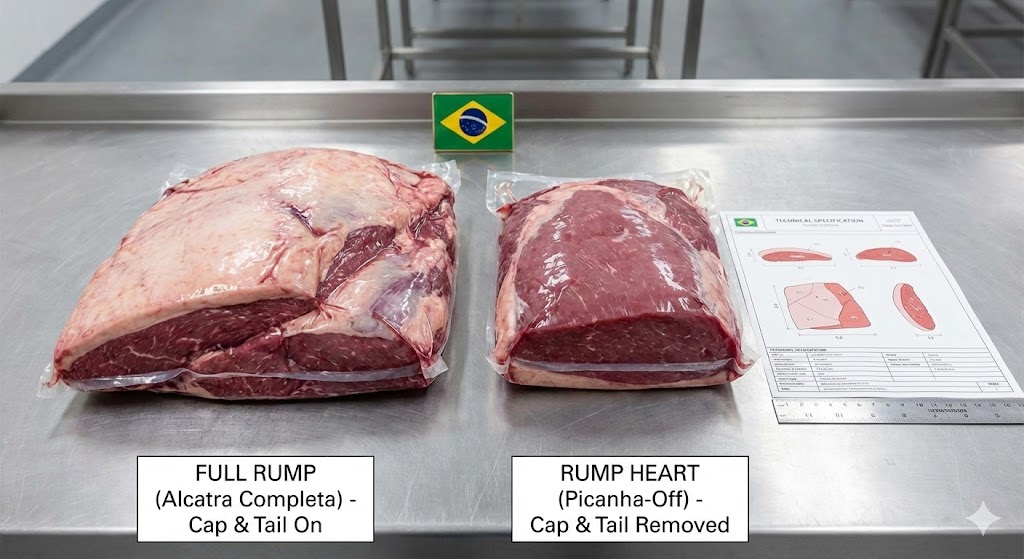
The beef rump—known in the Brazilian trade as the Alcatra—stands as one of the most commercially significant primals for the global B2B market. In 2026, international buyers increasingly value this cut for its exceptional balance between tenderness, lean muscle mass, and deep beefy flavor. Because the rump serves as a versatile source for premium steaks, roasting joints, and high-quality dicing meat, mastering its technical fabrication is essential for optimizing retail margins. Consequently, Brazil has standardized the processing of the beef rump to meet the rigorous demands of both European and Asian procurement standards.
At GlobalExporter-BR, we connect professional wholesalers with Brazil’s most technologically advanced SIF-certified plants. We recognize that your success depends on the precision of the “Heart” vs. “Cap” separation. To learn more about our broader commitment to excellence in the global food supply chain, you can visit our official profile on Medium.
1. Anatomy and Component Parts
The beef rump originates from the Hindquarter, specifically the area where the loin meets the leg. Unlike simpler cuts like the Beef Tenderloin, the rump is a complex primal consisting of several distinct muscle groups.
The Breakdown of the Alcatra
The Brazilian fabrication of the beef rump typically involves the separation of three primary components:
-
Rump Heart (Miolo da Alcatra): This is the large, central muscle. It offers a tenderness that rivals the Beef Striploin but features a more intense flavor profile.
-
Rump Cap (Picanha): Specifically, the Picanha is the most famous part of the rump. While we often sell it as a standalone premium item, it anatomically belongs to the rump primal.
-
Rump Tail (Maminha): This small, triangular muscle is exceptionally juicy and popular for grilling.
2. Technical Export Specifications (The Trim)
Brazilian packers offer the beef rump in various trim levels. Your choice of specification determines the final yield of your “center-of-the-plate” offerings.
Full Rump (Alcatra Completa)
In this configuration, the packer ships the heart, cap, and tail together in a single vacuum bag. Consequently, the price per kilo is lower. Nevertheless, the buyer must possess the butchery skill at the destination to separate the high-value Picanha from the rest of the primal.
Rump Heart (Cap-Off / Picanha-Off)
This represents the preferred standard for high-end European retail. The butcher removes the Picanha and the Tail at the plant. Specifically, the “Heart” spec provides a clean, large muscle block that is ideal for cutting uniform “Rump Steaks.” Furthermore, we often grade these based on weight ranges to ensure consistency in your portion control. For a technical breakdown of the fat content in these muscles, refer to our Beef Marbling Guide.
3. The SIF and Quality Assurance Protocol
Because the beef rump contains several different muscle fibers, maintaining strict temperature control during the “post-mortem” phase is paramount to avoid toughness. Accordingly, the SIF (Serviço de Inspeção Federal) monitors the aging process closely.
-
pH Monitoring: Inspectors test the rump to ensure a pH below 5.8. High-pH meat results in a dark color and gummy texture. Consequently, our SIF plants exclude such carcasses from the premium export chain.
-
Vacuum Integrity: Because the rump has more “seam fat” than the Beef Knuckle, the vacuum seal must be perfect to prevent fat rancidity. Specifically, we use high-barrier shrink bags to ensure a 120-day chilled shelf life.
4. 2026 Logistics: Chilled Aging
The logistics strategy for the beef rump leverages the transit time to enhance the eating quality.
Wet Aging for the Global Market
Most premium beef rump shipments from Brazil travel as chilled cargo. Specifically, we maintain the reefer containers at -1.5°C. During the 30-to-40-day voyage, natural enzymes break down the connective tissues within the rump muscles. Consequently, the steaks reach peak tenderness exactly when they arrive at your warehouse. Notwithstanding the higher logistics cost compared to frozen meat, the value added by “aging in transit” allows for a significantly higher retail price.
21 Frequently Asked Questions (FAQs) About Beef Rump
1. What is the Brazilian name for Beef Rump?
In the Brazilian market, the beef rump is known as Alcatra.
2. Is the Picanha included in a “Full Rump” order?
Yes. If you order the Alcatra Completa, the Picanha remains attached. Conversely, the “Rump Heart” spec excludes the Picanha.
3. What is the difference between Rump and Sirloin?
Anatomically, the rump sits just behind the sirloin (striploin). While the sirloin is a single muscle, the rump is a group of muscles with a deeper flavor but slightly more texture.
4. What is the best way to cook beef rump steaks?
Because it is a lean but flavorful cut, quick searing or grilling to medium-rare is ideal. Furthermore, it is excellent for traditional roasts.
5. Why is the Rump Heart popular in Europe?
European buyers value the Rump Heart for its lean profile and its ability to be sliced into large, uniform, high-value steaks.
6. Are Brazilian beef rumps Halal certified?
Yes. GlobalExporter-BR sources exclusively from SIF-certified plants that maintain 100% Halal certification for global export.
7. What is the typical weight of a Brazilian Rump Heart?
Export-grade Rump Hearts typically weigh between 3kg and 5kg.
8. What is the “Maminha”?
The Maminha is the Rump Tail. It is a triangular muscle prized for its juiciness and flavor when roasted or grilled.
9. Does the rump have more flavor than the tenderloin?
Yes. Most chefs agree that the beef rump offers a significantly more robust “beefy” flavor than the leaner Beef Tenderloin.
10. How do you ensure the rump is tender?
We ensure tenderness through genetic selection (Angus crossbreeding) and a minimum of 21 days of “wet aging” during transit.
11. What is the shelf life of chilled vacuum-packed rump?
Under optimal conditions (-1°C), it has a shelf life of approximately 90 to 120 days.
12. Can I buy frozen beef rump?
Yes. While chilled is the premium standard, we offer blast-frozen rumps for industrial dicing or long-term storage.
13. What is the Minimum Order Quantity (MOQ)?
The standard MOQ is one 40ft reefer container (approx. 27 tonnes).
14. Is Brazilian beef rump grass-fed or grain-fed?
We offer both. However, the premium export grade is typically grain-finished for 120 days to improve the fat color and tenderness.
15. Why is the fat on the rump white?
White fat indicates a grain-finished diet. Conversely, yellow fat usually indicates an older, exclusively grass-fed animal.
16. What is the “Three-Muscle” rump spec?
This refers to a rump that has been fabricated to remove the cap and tail, leaving only the heart, which is composed of three internal muscle groups.
17. How is the product packaged for export?
Each primal is Individually Vacuum Packed (IVP), and then 3 to 5 pieces are placed in a heavy-duty master carton.
18. Does Brazil use growth hormones?
No. The use of growth hormones in cattle is strictly prohibited by Brazilian law and monitored by federal SIF inspectors.
19. How do you prevent “Dark Cutters” in rump shipments?
Every carcass undergoes a pH test. Any rump with a pH above 5.8 is rejected from the premium export program.
20. How does the price of rump compare to the Striploin?
The beef rump is generally more affordable than the Beef Striploin, offering a higher profit margin for retailers.
21. How do I get a price quote for a bulk order?
Visit the contact page on GlobalExporter-BR and provide your target spec, destination port, and monthly volume.
 Spanish
  English