
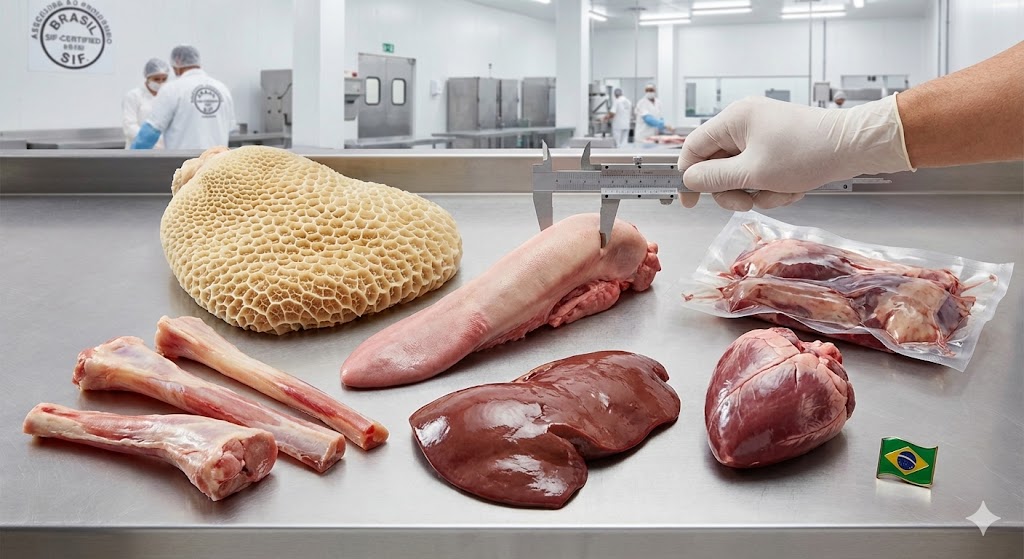
In the intricate world of global protein trade, beef offal—often referred to as “variety meats”—represents one of the most dynamic and profitable sectors for international B2B importers. While muscle cuts like ribeye and striploin command high prices in the steakhouse circuit, the diverse category of offal is the lifeblood of traditional cuisines and industrial food processing across Asia, the Middle East, and Africa. As we move into 2026, Brazil has solidified its position as the premier global hub for high-quality, SIF-certified variety meats, offering a supply chain that balances massive scale with meticulous sanitary precision.
At GlobalExporter-BR, we recognize that for a professional procurement officer, the term beef offal encompasses a vast range of technical specifications. From the cleaning of honeycomb tripe to the precise trimming of bovine tongues, every product requires a specific protocol. To understand our broader commitment to agricultural excellence and our role in the global supply chain, you can visit our official profile on Medium.
[Image Placeholder: A professional display of cleaned, vacuum-packed beef offal cuts including liver, heart, and tripe on a stainless steel inspection table.] Alt Text: Assorted premium beef offal cuts ready for international export from a SIF-certified Brazilian facility.
1. Defining the Category: High-Value Variety Meats
The term beef offal refers to the internal organs and entrails of a butchered animal. In the Brazilian export context, these are not treated as “by-products” but as “specialty products.”
The “Big Five” of Brazilian Export
-
Honeycomb Tripe (Omasum/Reticulum): Highly sought after in East Asia and Southern Europe.
-
Beef Liver: A nutritional powerhouse in high demand across African and Middle Eastern markets.
-
Beef Tongue: A premium delicacy in Japan, Korea, and Latin America.
-
Beef Heart: Essential for the Peruvian market and industrial sausage manufacturing.
-
Beef Aorta and Tendons: Specialized items used in traditional Asian medicine and high-collagen food products.
2. Technical Specifications: The Grade A Standard
Sourcing beef offal is more complex than sourcing muscle meat because the “cleaning” process is much more intensive. In 2026, the global standard for Grade A variety meats is defined by the quality of the “Pre-Processing.”
Cleaning and Trimming Protocols
-
Tripe (Honeycomb/Flat): Must be scalded and bleached (where permitted) or cleaned with specialized brushes to remove all stomach contents and the dark inner lining. The final product should be creamy white and free from any odor.
-
Beef Liver: Must be “vein-free” and have the gallbladder removed without puncturing it. The color should be a consistent deep burgundy without yellowing (which indicates high fat or age).
-
Beef Tongue: Graded by the “Swiss Cut” (short cut) vs. “Long Cut.” The Swiss Cut is the premium standard, with the hyoid bone and excess fat at the base removed.
SIF and Health Certification
Every kilogram of beef offal exported from Brazil is under the supervision of the SIF (Serviço de Inspeção Federal). This is crucial for variety meats because organs are more susceptible to bacterial growth. The SIF ensures that the organs are harvested under sterile conditions and blast-frozen immediately to lock in freshness. To see our full list of SIF-approved facilities, visit our homepage.
[Image Placeholder: A close-up of a SIF inspector checking the internal temperature of a pallet of frozen beef liver.] Alt Text: Technical SIF inspection of frozen beef offal to ensure international sanitary compliance.
3. Market Trends: The 2026 Demand Shift
Why is beef offal seeing such a surge in demand in 2026? It is a combination of two factors: culinary heritage and the “nose-to-tail” sustainability movement.
The Rise of Industrial Processing
Beyond traditional cooking, variety meats are increasingly used as “functional ingredients.” For example, beef tendons and lungs are being processed into high-protein flours and collagen supplements. This industrial demand has created a “price floor” for offal that makes it a stable investment for B2B wholesalers.
Regional Preferences
-
China and Vietnam: Insatiable demand for omasum (tripe) and beef feet.
-
Egypt and Saudi Arabia: Massive markets for beef liver and hearts.
-
Japan: High-value demand for “Black Tongue” (Angus/Wagyu) and entrails for Yakiniku.
4. Logistics: The Cold Chain for Variety Meats
The logistics of beef offal are unforgiving. Organs have a higher moisture content than muscle meat, making them prone to spoilage if the temperature fluctuates.
Packing and Freezing
-
Blast Freezing: All variety meats must be blast-frozen to -30°C within 24 hours of slaughter.
-
Vacuum Skin Packaging (VSP): For premium items like tongue, VSP is used to prevent oxidation and freezer burn, which can turn the meat grey.
-
Bulk Poly-lining: For items like liver or tripe, heavy-duty poly-lined cartons (usually 10kg or 20kg) are the standard to prevent leakage.
Understanding these logistics is as important as monitoring Chicken Prices or Beef Meat Grading. Variety meats are often the first to be affected by port delays, so choosing a Global Exporter BR with priority reefers is essential.
5. Pricing and Economic Forecast for 2026
The pricing of beef offal is often inversely related to muscle meat. When the price of “Noble Cuts” (picanha, ribeye) rises, many consumers shift to variety meats as an affordable protein source. However, for “Gourmet Offal” (like tongue), the price remains high and stable regardless of the economy.
The “Yield” Economics
In a 500kg steer, only about 15-20kg is high-value export-grade offal. This scarcity, combined with the high labor cost of cleaning, means that Grade A offal often commands a premium that surprises first-time buyers.
21 Frequently Asked Questions (FAQs) About Beef Offal
1. What exactly counts as beef offal in export?
It includes all internal organs (liver, heart, lungs, kidneys), the stomach (tripe), and extremities like the tongue, tail, and feet.
2. Is Brazilian beef offal Halal certified?
Yes. At GlobalExporter-BR, all of our beef products, including variety meats, are 100% Halal certified, following strict Islamic slaughter and handling rites.
3. What is the most expensive type of beef offal?
Beef tongue (specifically the “Swiss Cut”) and the Omasum (honeycomb tripe) are generally the most expensive due to high demand in Japan and China.
4. How do you ensure the tripe is clean?
The tripe undergoes multiple stages of mechanical cleaning, scalding at 60-65°C, and manual inspection to ensure 0% stomach content remains.
5. Why is the SIF seal important for variety meats?
Organs are biologically active and sensitive to heat. The SIF seal guarantees that the product was harvested in a sterile environment and properly chilled.
6. What is the shelf life of frozen beef offal?
When stored at -18°C, the standard shelf life is 24 months. However, for liver, some buyers prefer a 12-month rotation to ensure maximum freshness.
7. What is the “Swiss Cut” for beef tongue?
It is a short cut where the hyoid bone, sublingual glands, and excess fat at the base are removed, leaving only the usable muscle.
8. Does beef offal have high nutritional value?
Yes, organs like the liver are exceptionally high in Vitamin A, B12, iron, and folic acid, often exceeding the nutritional density of muscle meat.
9. What are the packaging options for B2B export?
Common options include 10kg or 20kg cartons. For premium cuts, we offer IVP (Individually Vacuum Packed) or VSP (Vacuum Skin Packaging).
10. Can I mix a container with different types of offal?
Yes, we often provide “Mixed Variety” containers (e.g., 50% liver, 25% heart, 25% tripe) to help wholesalers manage their inventory.
11. What is the “Omasum” and why is it popular?
The Omasum is the third stomach of the cow. It has a unique leafy texture that is highly prized in Chinese hot pot and stir-fry dishes.
12. Are there any restrictions on exporting offal to China?
Yes. Only specific Brazilian plants with GACC (General Administration of Customs of China) approval can ship to the mainland. We provide access to these plants.
13. How is beef offal transported to prevent spoilage?
In 40ft High Cube Reefer containers maintained at a constant -18°C with digital temperature logging.
14. What is the difference between green tripe and white tripe?
Green tripe is uncleaned (used for pet food). White tripe has been cleaned, scalded, and often bleached for human consumption.
15. Why does the color of beef liver vary?
Natural variation occurs based on the animal’s diet, but for export, we select only the consistent “Chocolate” or “Dark Red” colors.
16. What is the Minimum Order Quantity (MOQ)?
The standard MOQ is one 40ft FCL (Full Container Load), which is approximately 27-28 metric tonnes.
17. Are beef tendons considered offal?
Yes, in the export trade, tendons (Achilles and flexor) are categorized as variety meats and are popular for their high collagen content.
18. How do you manage the “smell” of variety meats?
Proper cleaning and immediate blast freezing are the only ways to ensure the product has a neutral, fresh smell upon thawing.
19. Can I request a private label for offal?
Yes, for long-term contracts, we can apply your brand’s logo and specific local language requirements to the cartons and bags.
20. What is the “Aorta” used for?
The beef aorta is popular in Southeast Asian cuisine for its crunchy texture and is often used in soups and cold salads.
21. How do I get a price quote for a bulk order of beef offal?
Visit the contact section of globalexporter-br.com and provide your destination port and the specific list of cuts you require.
 Spanish
  English