
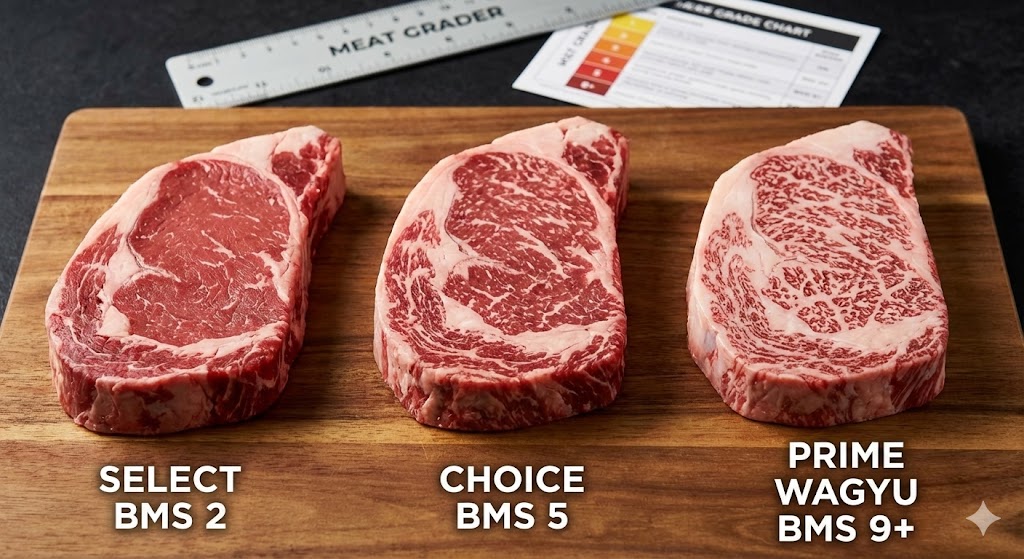
Beef marbling is the single most important determinant of eating quality, tenderness, and flavor in the international protein trade. For B2B procurement officers, wholesalers, and high-end restaurateurs, understanding the nuances of intramuscular fat (IMF) is the difference between a standard commodity and a premium luxury product. As we move into 2026, the global demand for highly marbled beef has reached unprecedented levels, driven by a culinary shift toward “umami-rich” experiences and the rise of specialized crossbreeding programs in South America.
At GlobalExporter-BR, we believe that technical knowledge is the foundation of a successful supply chain. Whether you are sourcing from the plains of Mato Grosso or the feedlots of Rio Grande do Sul, the ability to decode marbling scores is critical. To understand our broader commitment to agricultural transparency and market intelligence, you can visit our official profile on Medium.
Alt Text: High-resolution close-up of premium beef marbling in a ribeye steak.
1. The Science of Beef Marbling: More Than Just Fat
To the untrained eye, fat is simply fat. However, in meat science, we distinguish between three types of adipose tissue:
-
Subcutaneous Fat: The “fat cap” on the outside of the cut.
-
Intermuscular Fat: The fat deposits between different muscles (often called “seam fat”).
-
Intramuscular Fat (Marbling): The fine flecks and streaks of fat located inside the muscle fibers.
Why Marbling Matters
The magic of beef marbling happens during the cooking process. Unlike external fat, which is often trimmed away, marbling is embedded within the meat. As the temperature rises, these fine fat deposits melt (render) at approximately 50°C.
-
Internal Basting: The melting fat bastes the meat from the inside out, preventing the muscle fibers from drying and toughening.
-
Flavor Carrier: Fat is the primary carrier of flavor compounds and aromatic molecules. Marbling provides that buttery, nutty, and rich mouthfeel that defines a “Prime” experience.
-
Lubrication: The rendered fat acts as a lubricant between muscle bundles, significantly reducing the “shear force” required to bite through the meat, which we perceive as tenderness.
Alt Text: Digital camera-based measurement of beef marbling in a SIF-certified facility.
2. Comparing Global Grading Systems (2026 Trends)
As a B2B buyer, you will encounter different grading terminologies depending on the origin of your product. In 2026, there is a push toward “Global Standardization,” but three systems remain dominant.
The USDA System (United States)
The USDA system is the most recognized in the Western world. It relies on a visual assessment of the ribeye between the 12th and 13th ribs.
-
Prime: Abundant marbling (Top 2-3% of production).
-
Choice: Moderate marbling (The retail standard).
-
Select: Slight marbling (Lean and economical).
The Japanese BMS Scale (Beef Marbling Standard)
The Japanese system is the world’s most stringent, utilizing a scale from 1 to 12.
-
BMS 1-3: Standard supermarket quality.
-
BMS 8-12: The elite “A5” category, where the meat appears pink or almost white due to the density of the fat.
The Australian MSA System
Meat Standards Australia (MSA) uses a more holistic approach, combining a marbling score (0 to 1100+) with other factors like maturity, pH, and hanging method to predict the “eating quality” of the meat.
3. The Brazilian Marbling Revolution
Brazil, long known for its lean, grass-fed Nelore beef, has undergone a radical transformation. In 2026, the Brazilian “Marbling Revolution” is centered on two key genetic paths.
The Angus-Nelore Cross (The “F1” Hybrid)
By crossing the heat-resistant Nelore with the high-marbling Angus, Brazil produces an “F1” hybrid that thrives in tropical climates while delivering a “Choice” to “Prime” equivalent marbling score. This has allowed GlobalExporter-BR to offer premium-grade beef at more competitive price points than traditional US or Australian origins.
The Brazilian Wagyu Program
A growing niche in the South of Brazil involves purebred and crossbred Japanese Wagyu cattle. These animals are grain-finished for up to 500 days, achieving BMS scores of 7-10. This product is specifically designed for the ultra-luxury markets of Dubai, Singapore, and Hong Kong. To see how these products compare to our other offerings, visit our homepage.
4. Feeding Programs: Grass-Fed vs. Grain-Finished
The degree of beef marbling is heavily influenced by the animal’s diet.
-
Grass-Fed (Pasture Raised): Produces leaner meat with “yellow fat” (due to beta-carotene in the grass). While healthier (higher Omega-3s), the marbling is usually lower, typically scoring 1-2 on the BMS scale.
-
Grain-Finished: Cattle are moved to feedlots for the final 100-200 days of their lives. A high-energy diet of corn and soy promotes the deposition of white, creamy intramuscular fat. This is the standard for anyone seeking a “Prime” or “Wagyu” experience.
Understanding these feeding cycles is as critical as monitoring Chicken Prices or Beef Meat Grading.
5. Technical Grading Tools in 2026: AI and Imaging
The subjective “human eye” is being replaced by objective technology. In 2026, leading Brazilian facilities utilize Video Image Analysis (VIA).
-
Hyperspectral Imaging: These cameras can “see” the chemical composition of the fat and muscle, providing an exact percentage of Intramuscular Fat (IMF).
-
AI Scoring: Algorithms compare the ribeye surface against a database of millions of carcasses to assign a marbling score that is 99% accurate and consistent, eliminating the variability of human graders.
6. Sourcing Strategy for B2B Profitability
When sourcing highly marbled beef, B2B buyers must balance quality with “Plate Cost.”
-
For Steakhouses: Aim for a BMS 4-6 (USDA Prime equivalent). This offers the “wow factor” of marbling without the astronomical cost of A5 Wagyu.
-
For Retail: Upper-Choice (BMS 3) remains the “sweet spot” for consumer volume.
-
For Processing: Lower-grade, lean Nelore beef is the most cost-effective for burger blends, where fat can be added back in a controlled ratio.
21 Frequently Asked Questions (FAQs) About Beef Marbling
1. What exactly is beef marbling?
It is the fine flecks of intramuscular fat found within the muscle tissue, resembling the pattern of marble stone.
2. Is marbling the same as the fat on the edge of my steak?
No. Edge fat is “subcutaneous” or “intermuscular” fat. Marbling is “intramuscular” fat, which is located inside the muscle itself.
3. Why does marbling make beef taste better?
Fat carries flavor compounds. When marbling melts during cooking, it bastes the meat from the inside, enhancing juice and aroma.
4. Which beef breed has the most marbling?
The Japanese Wagyu (specifically the Kuroge Washu breed) is genetically predisposed to have the highest levels of marbling in the world.
5. Does grass-fed beef have marbling?
Yes, but typically much less than grain-fed beef. Grass-fed beef is leaner and often has a firmer texture.
6. What is the highest marbling score possible?
In the Japanese system, the highest score is a BMS 12. In the Australian system, it is 9+.
7. How does a cow develop marbling?
It is a combination of genetics and a high-energy diet (usually grain) in the final months before slaughter.
8. Is highly marbled beef less healthy?
While it has more calories and fat, marbled beef is high in monounsaturated fats (like oleic acid), which are similar to those found in olive oil.
9. What is the difference between USDA Prime and Choice?
Prime has “Abundant” marbling, while Choice has “Moderate” to “Small” amounts. Only about 2-3% of US cattle reach Prime.
10. Does age affect beef marbling?
Yes. Older animals have more time to deposit fat, but they also become tougher. The “sweet spot” is usually 24-30 months of age.
11. Can marbling be “fake”?
In some lower-end markets, fat is injected into lean meat. This is called “artificial marbling” and is illegal in premium export markets like the ones GlobalExporter-BR serves.
12. Why is Brazilian beef marbling becoming so popular?
Because Brazil’s crossbreeding (Angus x Nelore) offers a “Prime” quality eating experience at a significantly lower cost than US or Australian beef.
13. Does the cut of meat affect the marbling?
Yes. The Ribeye and Striploin naturally have more marbling than leaner cuts like the Tenderloin or Top Round.
14. How do I cook a highly marbled steak?
High heat and a shorter cooking time. You want to render the fat quickly without overcooking the delicate muscle fibers.
15. What is the BMS (Beef Marbling Standard)?
It is the Japanese scale used to grade the amount and distribution of fat in a ribeye, ranging from 1 to 12.
16. What is “Visual Marbling” vs. “Chemical Marbling”?
Visual marbling is what a grader sees. Chemical marbling is the actual laboratory measurement of the fat percentage in the muscle.
17. Does stress affect marbling?
Yes. High-stress cattle produce “dark cutters” with high pH, which ruins the appearance and quality of the marbling.
18. What is the “F1” crossbreed?
It is the first generation cross between two breeds (e.g., 50% Angus and 50% Nelore), combining the best traits of both.
19. How do I verify the marbling score of a shipment?
Every shipment from Brazil comes with a grading certificate and SIF inspection report that confirms the quality grade.
20. Is Wagyu marbling different from Angus marbling?
Wagyu marbling is typically finer and more evenly distributed (“snowflake marbling”), whereas Angus marbling often appears in thicker streaks.
21. How do I get a quote for premium marbled beef?
Visit our contact page and specify your required BMS or USDA equivalent score for a customized B2B quote.
 English
  Spanish