
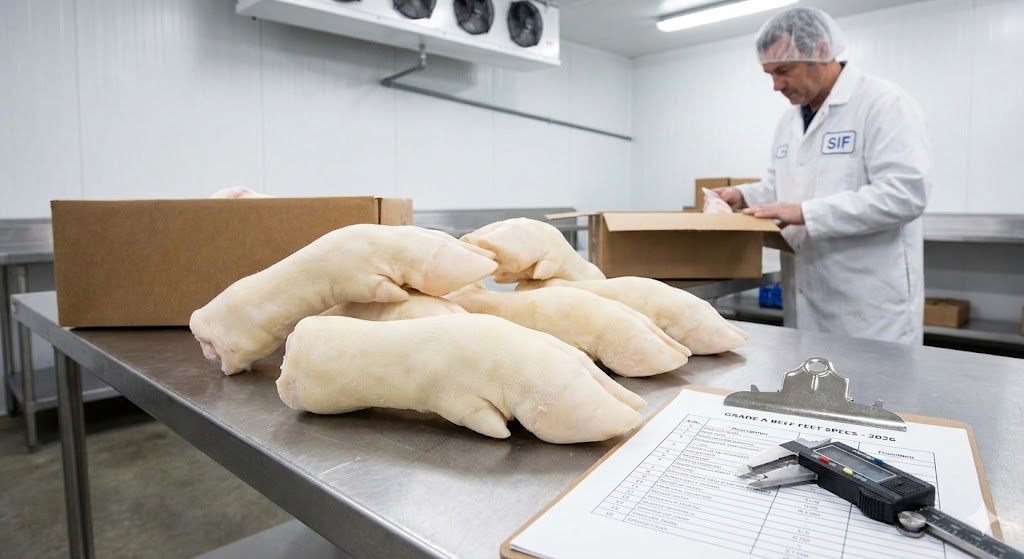
Sourcing high-quality beef feet represents a specialized yet highly lucrative segment of the international protein trade. As we navigate 2026, global demand for this collagen-rich commodity continues to surge across Asia, Africa, and the Middle East. While many consider this a secondary product, professional B2B buyers recognize that the technical quality of the cleaning and freezing process determines the final market value. Specifically, the Brazilian export market has set new benchmarks for sanitary compliance and processing efficiency.
At GlobalExporter-BR, we provide the technical transparency you need to procure SIF-certified beef feet at scale. We understand that your profitability depends on the exactness of the de-hairing and the integrity of the cold chain. To learn more about our commitment to excellence in the global food supply chain, you can visit our official profile on Medium.
1. Technical Specifications: What Defines Grade A?
The market value of beef feet depends entirely on the visual and sanitary condition of the product. Consequently, buyers must understand the “Grade A” criteria used by Brazilian packers.
The Cleaning Protocol
Processing facilities must follow a rigorous cleaning sequence to ensure the product meets international food safety standards.
-
De-hairing: Specialists use high-temperature scalding and mechanical scrapers to remove all hair. Any remaining follicles significantly reduce the grade of the product.
-
Cuticle Removal: The processor must remove the outer yellow skin (hoof shell) completely.
-
Washing: The facility uses high-pressure water jets to eliminate all traces of blood and bone fragments. Furthermore, the final product must appear creamy white and feature a neutral odor.
2. Market Demand: Collagen and Culinary Heritage
The demand for beef feet is not monolithic; instead, it splits between traditional culinary use and the burgeoning industrial collagen sector.
Culinary Applications
In regions like Southeast Asia and the Middle East, chefs prize beef feet for their high gelatin content. Specifically, they use the feet to thicken soups and stews. Consequently, these buyers prioritize the “Jumbo” size (usually 800g+) to ensure a high meat-to-bone ratio.
The Collagen Industrial Boom
By 2026, the health and wellness industry has transformed the economics of this cut. Manufacturers now process beef feet into hydrolyzed collagen peptides. Because the skin and tendons of the feet contain dense type I and III collagen, this product serves as a primary raw material for the global supplement industry. If you are also interested in other high-collagen variety meats, you should consult our Beef Offal Export Guide.
3. The SIF and Sanitary Advantage in Brazil
The SIF (Serviço de Inspeção Federal) seal guarantees that every shipment of beef feet undergoes federal veterinary supervision.
-
Microbiological Safety: Inspectors test every batch for pathogens like E. coli and Salmonella.
-
Temperature Control: Because variety meats are biologically active, the facility must blast-freeze the product to -30°C within hours of slaughter. This prevents the “reddening” of the joints, which indicates temperature abuse. For more on how we manage high-value beef, see our Brazilian Ribeye Guide.
4. Logistics: Packaging and Container Yield
Shipping beef feet internationally requires meticulous attention to weight density and packaging durability.
Packaging Standards
-
Bulk Poly-lined Cartons: Most exporters use 10kg or 20kg master cartons with heavy-duty internal liners to prevent leakage during thawing.
-
Individually Poly-bagged (IPB): For premium retail markets, we offer individually bagged feet, which prevents the product from sticking together (ice-blocking).
Loading Capacity
A 40ft High Cube Reefer container typically carries approximately 27-28 metric tonnes of beef feet. Furthermore, the shipping temperature must remain constant at -18°C. Notwithstanding the lower price point compared to Premium Beef Cuts, the freight costs for feet are identical, so maximizing container volume remains essential for your margins.
21 Frequently Asked Questions (FAQs) About Beef Feet
1. What is the difference between “Beef Feet” and “Cow Heels”?
In most export markets, these terms are used interchangeably. However, “Beef Feet” usually refers to the entire hoof section up to the joint.
2. Is the hoof shell removed?
Yes, Grade A specifications require the complete removal of the hard yellow hoof shell.
3. Are these products Halal certified?
Yes, most Brazilian export plants maintain Halal certification through accredited bodies like FAMBRAS.
4. What is the average weight of a single beef foot?
Weights generally vary between 600g and 1.2kg per piece, depending on the age and breed of the animal.
5. Why do some beef feet look yellow?
A yellow tint often indicates poor scalding or incomplete removal of the outer cuticle. Grade A products must be creamy white.
6. What causes “Red Joints” in frozen beef feet?
This usually results from slow freezing or temperature fluctuations during transit, which allows blood to seep into the joint area.
7. How many beef feet fit in a 20kg carton?
A 20kg carton typically contains between 18 and 24 pieces, depending on the calibration.
8. What is the shelf life of frozen beef feet?
When maintained at -18°C, they have a shelf life of 24 months from the production date.
9. Can I buy “uncleaned” beef feet?
We generally only export fully cleaned products for human consumption, though “Green” (uncleaned) feet are available for pet food processing.
10. Does Brazil export beef feet to China?
Yes, specific plants with GACC approval can ship variety meats, including feet, to the Chinese mainland.
11. What is the MOQ for a shipment?
The Minimum Order Quantity is one 40ft reefer container (approximately 27-28 tonnes).
12. Are beef feet high in protein?
They are extremely high in collagen protein, though they contain less muscle protein than steaks.
13. How are they cleaned without chemicals?
Brazilian plants use mechanical friction and high-temperature water (scalding) rather than harsh chemicals.
14. Can I request a specific size (Calibration)?
Yes, we can offer “Jumbo” (800g+) or “Medium” (600g-800g) calibrations for large-volume contracts.
15. Why is the SIF number important?
The SIF number identifies the specific facility that processed the meat, allowing for full traceability back to the farm.
16. Do you use growth hormones on the cattle?
No, Brazil strictly prohibits the use of growth hormones in cattle production.
17. How do I prevent the boxes from crushing during transit?
We use high-burst-strength cardboard and avoid over-stacking the pallets inside the reefer.
18. What is the transit time to the Middle East?
Typically, shipments take between 25 and 35 days from the port of Santos or Itajaí.
19. Are these suitable for making gelatin?
Yes, the high collagen content makes them an ideal raw material for industrial gelatin production.
20. How is the weight calculated?
We use “Net Weight,” which excludes all packaging materials like cartons and poly-liners.
21. How do I get a price quote for beef feet?
Visit the GlobalExporter-BR contact page and provide your destination port and required volume.
 English
  Spanish