
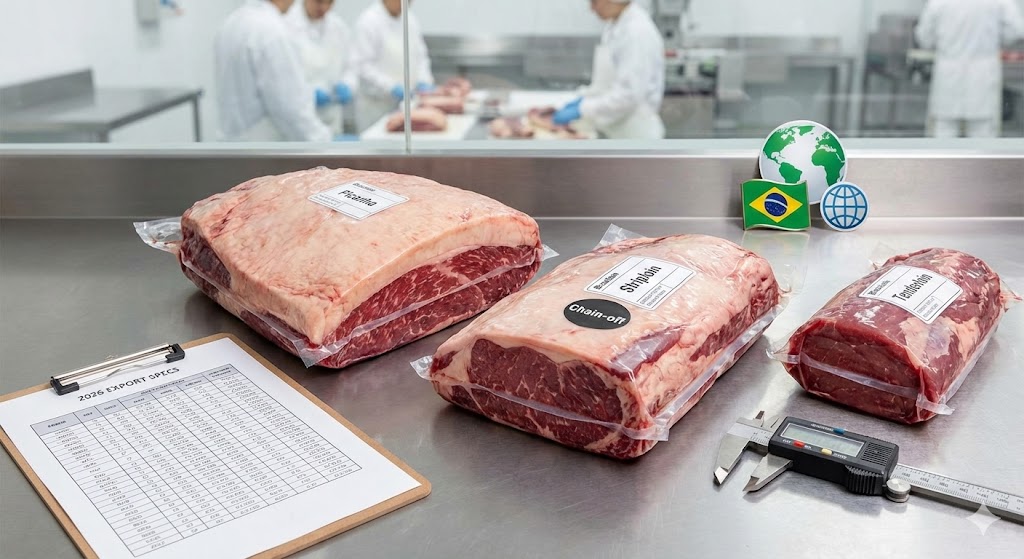
Beef Cuts: The 2026 Technical Guide to Brazilian Export Specs
Mastering the precise fabrication of beef cuts serves as the foundation for any successful international procurement strategy. In the global protein market of 2026, professional buyers no longer prioritize volume alone; instead, they demand technical precision during the “Primal” and “Sub-primal” breakdown. Whether you operate as a wholesaler in Southeast Asia, a retailer in Europe, or a food manufacturer in the Middle East, your ability to specify exact trim, fat cover, and muscle separation for your beef cuts directly determines your final yield and profitability.
At GlobalExporter-BR, we bridge the gap between Brazil’s massive ranching infrastructure and the exacting standards of global B2B partners. We provide the technical transparency you need to navigate the SIF-certified facilities of the Brazilian interior. To learn more about our commitment to excellence in the global food supply chain, you can visit our official profile on Medium.
1. The Primary Breakdown: From Carcass to Primal
The journey of Brazilian beef cuts begins when the processor divides the carcass into four primary quarters. In the international export trade, specialists generally categorize these sections into the “Forequarter” and the “Hindquarter.”
The Forequarter (Front Section)
The forequarter contains muscles that perform significant mechanical work. Consequently, these sections produce cuts with more connective tissue but exceptionally intense flavor.
-
Chuck (Paleta): This section provides excellent dicing meat and the increasingly popular “Flat Iron” steak.
-
Brisket (Peito): This cut remains a staple for industrial processing and the global BBQ market.
-
Rib (Costela): This is where producers harvest the premium Brazilian Ribeye. Furthermore, if you require a deep dive into this high-value cut, you should consult our guide on Brazilian Ribeye Sourcing.
The Hindquarter (Rear Section)
The hindquarter houses the most tender and expensive beef cuts. Because these muscles carry less of the animal’s weight, they offer a superior texture.
-
Loin (Lombo): This area acts as the source for the Striploin and Tenderloin.
-
Round (Coxão): This category includes the Topside and Silverside, which retailers use primarily for roasting and lean steaks.
2. Technical Specifications of High-Value Sub-Primals
For the B2B buyer, the “Sub-primal” represents the actual unit of trade. By 2026, Brazilian packers have successfully standardized these beef cuts to align perfectly with North American (NAMP/IMPS) and European (UNECE) nomenclature.
Picanha (Rump Cap) – The Brazilian Signature
Picanha stands as arguably the most famous of all Brazilian beef cuts. Specifically, it is the triangular muscle located at the top of the rump.
-
Technical Spec: Every export-grade picanha must feature a consistent white fat cap measuring between 1cm and 1.5cm.
-
The “Three-Vein” Rule: To guarantee tenderness, the butcher must cut the picanha at the third vein. Consequently, any meat beyond that point falls into the tougher “Rump Tail” category.
Striploin (Contra Filé)
The Striploin serves as a primary steakhouse staple. In Brazil, graders categorize these beef cuts based on the degree of intramuscular fat.
-
Export Trim: Packers usually offer this as a “Chain-off” spec. This means the butcher removes the side muscle to provide a clean, uniform steak appearance. For additional details on how we grade fat within these muscles, refer to our Beef Marbling Authority Guide.
3. Industrial and Manufacturing Beef Cuts
While many buyers focus on steaks, a significant portion of Brazil’s export volume consists of manufacturing beef. Producers use these beef cuts for burgers, sausages, and ready-meals.
Forequarter 80/20 and 90/10
These ratios refer to the “Chemical Lean” (CL) content of the meat.
-
90CL: This specifies 90% lean meat and 10% fat. Chefs consider this the gold standard for premium burger blends.
-
80CL: Processors use this for standard applications where higher fat content improves flavor and binding.
Shin and Shank (Musculo)
Butchers harvest these high-collagen beef cuts from the legs. Consequently, they are essential for producing soups, stews, and gelatin-rich food products. Their value has increased significantly in 2026 because the global market now demands more natural collagen sources.
4. The SIF and Sanitary Protocol for Variety Meats
In Brazil, the SIF (Serviço de Inspeção Federal) ensures that every single cut—whether a premium fillet or beef offal—meets identical, rigorous health standards.
Variety meats, such as tongue, heart, and tripe, require specialized handling. Because these organs react sensitively to temperature, the facility blast-freezes them immediately after fabrication. For a technical breakdown of these specialized items, you can explore our Beef Offal Export Guide.
5. 2026 Trends: Case-Ready and Value-Added Cuts
The 2026 market is moving away from bulk primals. Instead, buyers now prefer “Case-Ready” solutions.
-
Portion Control: Modern retailers now import beef cuts that the packer has already sliced, tray-packed, and labeled in Brazil. This strategy reduces labor costs at the final destination.
-
VSP (Vacuum Skin Packaging): This technology extends the shelf life of chilled beef cuts up to 90 days. As a result, companies can use sea freight for products that previously required expensive air-freight logistics.
6. Logistics: Maximizing Container Yield
Shipping beef cuts internationally requires meticulous space optimization.
-
Standard Loading: A 40ft High Cube Reefer container typically carries approximately 27-28 metric tonnes of boxed beef.
-
Frozen vs. Chilled: Packers usually pack frozen beef in 20kg-25kg cartons. Conversely, they individually vacuum-pack (IVP) chilled beef primals into smaller 10kg-15kg boxes to prevent crushing during transit.
21 Frequently Asked Questions (FAQs) About Beef Cuts
1. What are the “Primal” beef cuts?
Primals are the first large sections removed from the carcass: Chuck, Rib, Loin, Round, Brisket, Shank, Plate, and Flank.
2. What is the most expensive beef cut in Brazil?
The Tenderloin (Filé Mignon) usually carries the highest price, followed closely by the Picanha and the Ribeye.
3. What is “Picanha” in the US or UK?
In the US, retailers call it the “Sirloin Cap.” In the UK, it usually forms part of the “Top Rump.”
4. What does “NAMP/IMPS” mean in beef specs?
These are standardized numbering systems used to identify specific beef cuts globally, ensuring buyers receive exactly what they ordered.
5. Why is the “Three-Vein” rule important for Picanha?
The muscle becomes tougher toward the rump. Consequently, cutting at the third vein ensures the customer receives only the tender portion.
6. What is the difference between Topside and Silverside?
Both originate from the Round. Topside is leaner and more tender for roasting, whereas Silverside usually requires slow cooking.
7. How do specialists grade “Manufacturing Beef” cuts?
They grade them by “Chemical Lean” (CL) percentage, such as 80CL, 90CL, or 95CL.
8. What is a “Silver Skin”?
This is the tough connective tissue found on many beef cuts. Premium export specs require the butcher to remove it entirely.
9. Are Brazilian beef cuts Halal?
Yes, most export plants in Brazil maintain Halal certification through accredited bodies like FAMBRAS.
10. What is the “Lip” on a Ribeye?
The lip is a small section of fat and muscle on the edge. Specs are typically “Lip-on” or “Lip-off.”
11. What is the “Chain” on a Tenderloin?
The chain is a thin strip of fat running along the side. Premium specs require it to be “Chain-off.”
12. Why does the pH of a beef cut matter?
A pH above 5.8 indicates a “Dark Cutter.” These have poor shelf life, so export cuts must remain below 5.8.
13. What is “Bone-in” vs. “Boneless”?
While boneless cuts improve shipping efficiency, bone-in cuts like Short Ribs offer superior flavor for specific cuisines.
14. What is the shelf life of vacuum-packed chilled beef?
Under optimal conditions (-1.5°C), it can last 90 to 120 days, making it ideal for sea freight.
15. How can I identify if a cut is Angus or Nelore?
Brazilian export boxes carry labels for specific breed programs if the meat meets those genetic criteria.
16. What is the “Knuckle” (Patinho)?
It is a lean muscle from the Round, which chefs often use for minute steaks or ground beef.
17. Why is Brazilian beef leaner than US beef?
Brazil relies heavily on grass-fed production, which naturally produces leaner beef cuts compared to grain-fed systems.
18. Can I buy “Portion-Cut” steaks from Brazil?
Yes, many modern plants now offer portion-controlled steaks ready for retail or food service use.
19. What is “Ageing” in the context of beef cuts?
Ageing allows natural enzymes to break down connective tissue, which significantly improves tenderness.
20. How do you calculate the weight of a shipment?
We use “Net Weight” (meat only) and “Gross Weight” (including all packaging materials).
21. How do I request a quote for specific beef cuts?
Visit the GlobalExporter-BR contact page and provide your technical spec and destination port.
 English
  Spanish